


To get more Mercari sales selling LEGO, treat it as a volume and discovery platform: use every one of Mercari's photo slots, write titles packed with set numbers and theme names, price a little below BrickEconomy comps to win the algorithm's "trending" boost, and bundle loose pieces into themed lots. In my experience, sellers who treat Mercari as a lazy afterthought get lazy results, but sellers who treat it like a real channel can turn it into steady weekly cash flow alongside eBay and Whatnot.
I've sold LEGO across nearly every marketplace out there, and Mercari has a specific personality. It rewards sellers who move fast, price competitively, and make buyers feel like they're getting a deal without a bidding war. It's not the platform where you'll get 30% over market value like you sometimes can on Whatnot, and it's not the deep-catalog precision of BrickLink. It's the platform where a parent scrolling on their phone at 9pm decides to buy a Star Wars minifigure lot for their kid because the photos looked clean and the price felt fair.
- Optimize titles and the first photo for Mercari's search and browse algorithm, not just SEO keywords.
- Price near or slightly under current BrickLink and BrickEconomy comps to trigger faster offers.
- Bundle minifigures and small parts into themed lots instead of listing single pieces one by one.
- Use Mercari's offer and promote features actively instead of letting listings sit static.
- Know your real margin after Mercari's selling fee before you commit to aggressive pricing.
Why Mercari Is Worth a Real Spot in Your LEGO Selling Rotation
Mercari is worth a real spot in your rotation because it puts your LEGO in front of casual buyers who aren't deep in the hobby, which means less price haggling over a $0.50 part and more "buy it now" behavior on clean, well-priced lots. In my experience, Mercari buyers move faster than BrickLink buyers and are less picky than eBay's bargain hunters, as long as your listing looks trustworthy.
I started treating Mercari as a secondary channel years ago, mostly for minifigure lots and small sealed polybags that didn't justify a full eBay listing with promoted placement. What surprised me is how often those "extra" listings turned into a meaningful chunk of monthly revenue. A seller I know runs almost her entire LEGO minifigure business through Mercari because her buyer base skews toward parents and casual collectors who want a quick, friendly transaction rather than a marketplace with auction-style pressure.
How Do You Set Up a Mercari LEGO Listing That Actually Converts?
A Mercari LEGO listing converts when the title includes the set name or theme plus "LEGO," the first photo is a bright, in-focus hero shot, and the description answers condition and completeness questions before a buyer has to ask. Mercari's search leans heavily on title keywords, so vague titles like "LEGO lot" get buried under thousands of similar posts.
I recommend front-loading titles with the theme (Star Wars, Marvel, Ninjago) and set number when you have one, since collectors search by both. In my view, the biggest mistake new Mercari sellers make is copying an eBay title format that's built for eBay's more advanced filters, when Mercari buyers are scrolling and searching in a simpler, more casual way.
What Photos Actually Get More Views on Mercari LEGO Listings?
Photos that get more views on Mercari LEGO listings are shot in natural light against a plain background, show every included piece or figure laid out clearly, and include a close-up of any print, sticker, or accessory that affects value. Mercari's feed is visual first, so your thumbnail photo is doing more selling work than your entire written description.
I've seen listings double their views just from swapping a dark, cluttered photo for one shot on a white poster board with even lighting. For minifigure lots specifically, lay every figure out in a grid so buyers can count pieces at a glance. If you're scanning and pricing a large haul, I use brick'em's haul calculator to sort a whole bin before I even think about staging photos, which saves a huge amount of time versus photographing and researching one figure at a time.
How Should You Price LEGO on Mercari to Sell Faster?
You should price LEGO on Mercari at or slightly below recent BrickLink and BrickEconomy sold comps, then leave a little room to accept Mercari's built-in offers, because Mercari buyers expect to negotiate and reward listings that feel like an active deal rather than a fixed price wall. Static, overpriced listings tend to sit for months without a single offer.
From what I've learned pricing thousands of pieces, Mercari shoppers respond well to round, friendly numbers ($8 instead of $8.37) and to sellers who respond quickly to lowball offers with a reasonable counter instead of ignoring them. Check current sold listings on BrickLink's marketplace and cross-reference with BrickEconomy's market data before you set a starting price, since both update more often than any static price guide.
Which LEGO Themes Sell Best on Mercari?
Star Wars, Marvel, and Ninjago tend to sell best on Mercari because they combine broad name recognition with active fandoms, while niche or low-liquidity themes like generic City figures often sit unsold for weeks. In my experience, Mercari's casual buyer base responds to characters they already recognize far more than to rare variants that only serious collectors would notice.
City minifigures, in particular, rarely sell for more than a couple dollars each even on a good day, so I don't build dedicated Mercari listings around them unless they're part of a larger bundle. Compare that to a Star Wars or Marvel lot, where recognizable characters can move quickly even at a modest markup. If you're unsure what's in a bin before you list it, brick'em's minifigure database is a fast way to confirm exactly what you're holding before you price it.
How Can Bulk Lots and Minifigure Scanning Speed Up Your Mercari Listings?
Bulk lots and minifigure scanning speed up your Mercari listings by letting you identify and price dozens of figures in one pass instead of researching each piece individually, which is often the single biggest time drain for resellers listing on a casual-browse platform like Mercari. Buying bulk lots at a discount and splitting them into themed Mercari bundles is one of the most consistent playbooks in LEGO reselling.
I noticed that most of the time I used to lose on Mercari wasn't photography or writing descriptions, it was figuring out what a random pile of minifigures actually was. When I sort a fresh haul now, I scan the whole lot at once, group figures by theme, and list the strongest pieces individually while bundling the rest. That workflow alone turned a few boxes of "I don't know what this is worth" inventory into listings I could publish the same afternoon.
What Do Mercari's Fees Mean for Your LEGO Margins?
Mercari charges sellers a selling fee taken as a percentage of the sale price, roughly in the 10 percent range as of this writing, on top of any payment processing costs, so a $20 minifigure lot nets meaningfully less than the sticker price once fees and shipping supplies are factored in. Always check Mercari's current fee schedule directly before you finalize pricing, since marketplace fee structures change without much notice.
I compare this constantly against other channels. eBay's total take rate can climb close to 25 percent once promoted listings are added in, while BrickLink's fees are typically much lower for smaller-dollar items, which is part of why I recommend using BrickLink's published fee schedule as a comparison point when you're deciding where a specific piece belongs. Mercari sits in a middle ground: higher fees than BrickLink for cheap items, but a buyer base that moves faster than a niche parts marketplace.
Heads up: This is not financial or legal advice. We're sharing what we've learned from the LEGO reselling community.
Mercari LEGO Seller Checklist
Use this checklist before you publish a new Mercari LEGO listing. Sellers I know who run through a checklist like this consistently see fewer stale listings sitting unsold past the 30-day mark.
| Step | Why It Matters |
|---|---|
| Title includes theme and set number | Matches how Mercari's search and casual browsers actually look for LEGO |
| First photo is bright, in focus, plain background | Thumbnail drives the click before anything else does |
| Priced near current BrickLink or BrickEconomy comps | Keeps you competitive without giving away margin |
| Condition and completeness stated in description | Reduces returns and pre-sale questions |
| Loose pieces grouped into themed bundles | Turns slow-moving singles into faster-selling lots |
| Offers responded to within a few hours | Mercari rewards active, responsive sellers with more visibility |
Common Mistakes That Kill Mercari LEGO Sales
The most common mistakes that kill Mercari LEGO sales are vague titles, dark or cluttered photos, ignoring offers for days at a time, and pricing straight off a set's original retail cost instead of current secondhand comps. Any one of these can quietly stall a listing that would otherwise sell within a week.
I learned the offer-response lesson the hard way. Early on I'd let lowball offers sit for a day or two out of annoyance, and I noticed my sell-through rate on those listings was noticeably worse than on listings where I countered within an hour. A seller I know sets a phone reminder to check Mercari offers twice a day specifically because of how much faster her lots move when she responds quickly.
Should You Diversify Beyond Mercari for LEGO Reselling?
You should diversify beyond Mercari because no single marketplace captures every type of LEGO buyer, and relying on one channel leaves you exposed if that platform's algorithm, fees, or buyer traffic shift. Mercari works best as one leg of a wider strategy that also includes higher-touch platforms.
I've built real revenue on eBay's LEGO minifigure category for broad reach, live-streamed on Whatnot's LEGO category for buyers willing to pay above market for the right piece, and sourced cheap inventory through Facebook Marketplace local listings. Mercari fills a specific gap: fast-moving, casual buyers who want a good deal without a bidding war. If you want to see how your current inventory stacks up across channels, brick'em's collection value calculator is a quick way to check total value before deciding where each piece should go.
Frequently Asked Questions
Is Mercari good for selling LEGO minifigures?
Yes, Mercari is good for selling LEGO minifigures, especially recognizable characters from Star Wars, Marvel, and Ninjago, because casual buyers browse by character rather than rare variant details. In my experience, bundled minifigure lots move faster on Mercari than single high-end figures, which tend to do better on BrickLink or Whatnot instead.
How do I price LEGO lots on Mercari?
Price LEGO lots on Mercari by checking recent sold comps on BrickLink and BrickEconomy, then setting a price slightly below that range to account for Mercari's negotiation culture and selling fee. Round, friendly price points tend to convert better than precise decimal pricing on a casual-browse marketplace like this one.
What LEGO sells worst on Mercari?
Generic City theme minifigures and loose common parts tend to sell worst on Mercari, since they rarely carry the character recognition or story value that drives casual buyer interest. Rare minifigures worth $2,000 to $3,000 also don't fit Mercari well, since that level of buyer typically shops BrickLink or specialist marketplaces instead.
Should I list the same LEGO on Mercari and eBay at once?
Yes, cross-listing the same LEGO on Mercari and eBay is common and can widen your buyer pool, as long as you cancel the other listing quickly once an item sells to avoid a double sale. Many resellers, myself included, treat Mercari as a lower-effort secondary listing rather than a full duplicate storefront.
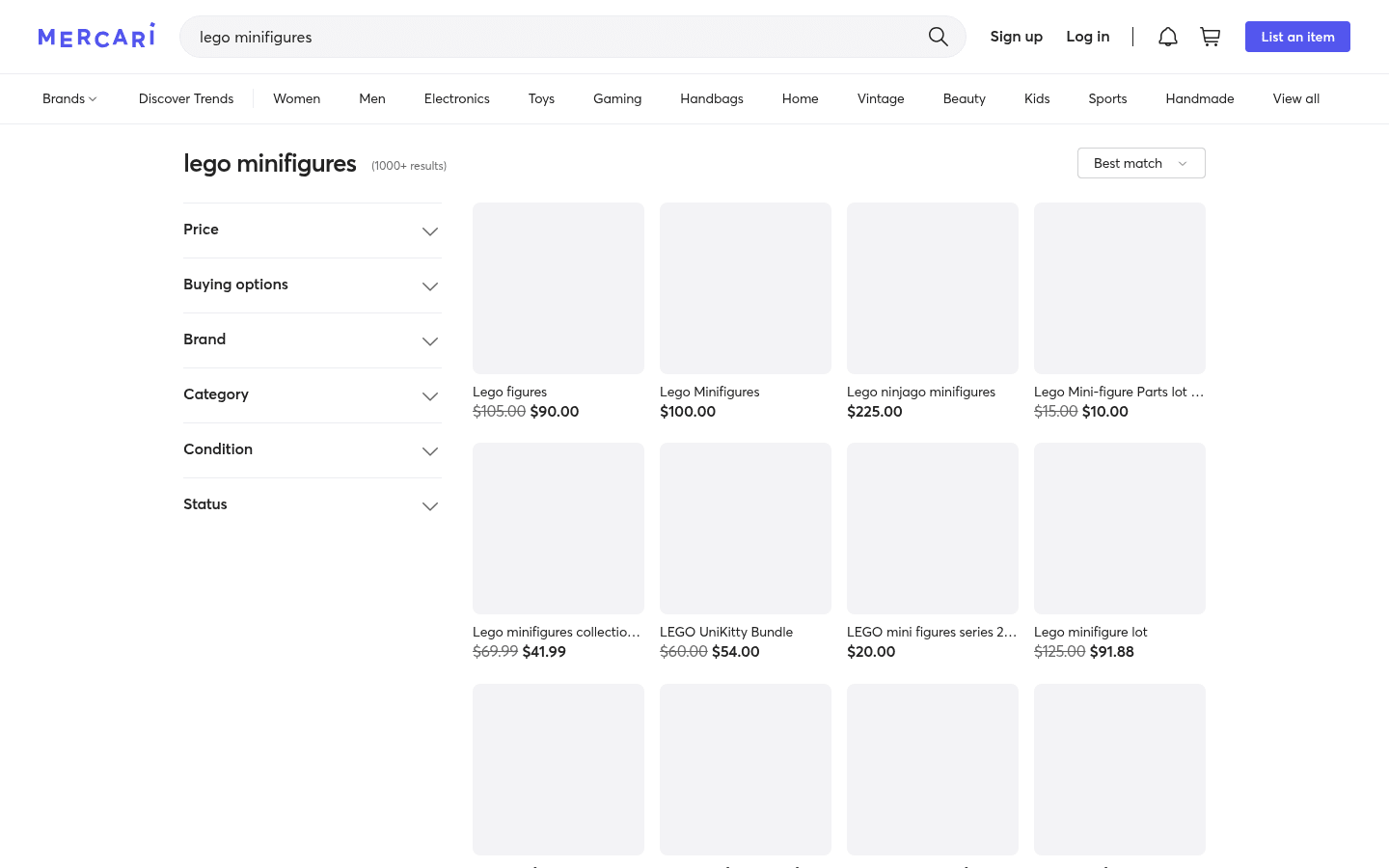
What Do These LEGO Selling Platforms Look Like?
Before choosing where to sell, it helps to see the difference between a live-selling marketplace, a broad search marketplace, a LEGO-native catalog, and a social or local channel. These screenshots are visual references only. Platform interfaces, fees, and rules can change.
CTA(Identify%20and%20Price%20100%2B%20Figures%20With%20One%20Pic).png)

