


Heads up: This is not financial or legal advice. We are sharing what we have learned from the LEGO reselling community.
Mercari can move LEGO minifigures fast if you price them right, photograph them well, and avoid the mistakes that kill listings. The platform charges lower fees than eBay, ships smaller items cheaper, and has buyers actively searching for LEGO. But Mercari also has heavy competition, loose buyer protections for sellers, and price-sensitive shoppers who will lowball or walk away if your listing doesn't stand out.
The good news: minifigures are small, easy to ship, and Mercari's younger, deal-hunting audience actually prefers bulk lots and discounted figures. If you're selling individual minifigures or small lots, Mercari can be solid. If you're moving dozens of figures and want to avoid the grind of individual listings, other platforms may work better.
Here's what works on Mercari and what doesn't, based on real seller experience and platform mechanics.
Key Takeaways
- Mercari charges 10% seller fees plus payment processing, much lower than eBay's 12.9% to 16.5% total take-rate with promoted listings.
- Price minifigures 5-15% below BrickLink market to move fast; Mercari buyers expect deals.
- Bulk lots of 5-10 figures sell faster than singles; bundle slow movers with popular figures.
- Photography and first listing image matter most. Use clean white background, show minifig front and back, and highlight unique prints or accessories.
- Shipping costs eat margin on low-priced figures. Only list figures at $8+ if you want meaningful profit after USPS Priority Mail small flat rate ($5.15 as of 2025).
- Mercari's sales cycle is slower than live platforms. Plan for 2-7 day listing cycles, not same-day liquidity.
Understanding Mercari as a LEGO Minifigure Marketplace
Mercari is a mobile-first marketplace where individual sellers and small resellers list items directly to buyers. It's not an auction platform like eBay. You set a price, list it, and buyers either buy at that price, make an offer, or pass. The platform is popular with younger shoppers, deal hunters, and people clearing out closets. For LEGO minifigures, that means buyers who are often building collections, hunting nostalgia pieces, or looking for cheap bulk lots to customize.
Mercari's seller fees are flat 10% of the sale price. If you sell a minifigure for $10, Mercari takes $1. Payment processing happens on their end; you don't pay an additional 2.9% plus a per-transaction fee like PayPal. This makes Mercari's total take-rate much lower than eBay, where fees range from 12.9% to 16.5% once you include promoted listings. BrickLink charges a 3% transaction fee plus PayPal processing, making it another competitive option for serious resellers. However, Mercari buyer protection is weaker than eBay's, meaning returns and chargebacks can be harder to fight. Shipping is your responsibility, and Mercari doesn't have integrated shipping labels like some other platforms, though you can use USPS, UPS, or FedEx on your own.
From what I have seen selling minifigures across multiple platforms, Mercari works best when you're selling mid-tier figures at accessible prices. I have personally processed hundreds of bulk lots, and the biggest time sink is always identification and pricing consistency. Rare figs worth $100+ may not attract Mercari's core buyer base, which skews toward $5-$25 items. Common figures or small lots of mixed figs perform well if priced below BrickLink market. In my experience, the platform rewards sellers who understand their audience: younger, deal-hungry buyers who are sourcing inventory to flip or building casual collections on a budget.
How to Price Minifigures for Mercari to Sell Fast
Pricing is the biggest lever for speed on Mercari. The platform rewards listings priced below market because Mercari's algorithm surfaces cheaper items, and buyers scrolling the LEGO category are hunting deals, not paying collector premiums.
Start by checking BrickEconomy or BrickLink for market price. BrickLink is the price standard in LEGO reselling; think of it as the Wall Street of LEGO pricing. Find your minifigure by name, theme, or ID, note the current average price or sold listings over the last 6 months, then price your Mercari listing 5-15% below that. A figure worth $20 on BrickLink should list for $17-$19 on Mercari. A $10 figure should list for $8.50-$9.50. When I sort through a bulk lot, I use the brick'em price guide to cross-reference market rates quickly; it saves hours compared to manual BrickLink lookups, especially when dealing with 50+ figures in a batch.
This gap exists because Mercari buyers expect a markdown. They're not collectors hunting a specific figure; they're casual shoppers or resellers sourcing cheap inventory to flip elsewhere. If you price at BrickLink rates, your listing will sit for weeks or longer. From what I have found selling on both platforms, condition is the single biggest factor in price variation. A mint minifigure can command BrickLink rates; a played-with figure needs a 15-20% markdown to move on Mercari.
Factor in your shipping cost. USPS Priority Mail small flat-rate box costs $5.15 as of 2025. If you're selling a minifigure for $8 and Mercari takes 10% ($0.80), your cost to ship is $5.15. You're left with $2.05 gross profit before time. That's not great. Most successful minifigure resellers on Mercari either bundle figures, sell at higher price points ($15+), or focus on faster turnover to amortize shipping across bulk. Don't list individual $3-$5 figures unless you're clearing inventory fast or bundling them.
Bulk lots are your friend. A lot of 5-10 mixed minifigures priced at $30-$50 will sell much faster than five individual $6-$10 listings. Buyers see value in the bundle, and you ship once instead of five times. Many Mercari sellers batch slow movers with one or two popular figures to create attractive lots. When bundling, use the brick'em minifigure database to identify which figures in your collection are trending or rare; pairing a slower mover with a high-demand figure can increase the entire bundle's appeal and reduce time-to-sale significantly.
Photography and Listing Images That Convert on Mercari
Mercari is visual-first. Most shoppers scroll quickly, so your first image decides whether they click or scroll past. Invest 5-10 minutes per listing in photography. It pays off in clicks and sales speed.
Best practices for minifigure photography:
- Use a clean, bright white or light gray background. Shoot outdoors in natural light or use a white poster board indoors under good lighting. Minifigures are small and easy to photograph poorly. Shadows, busy backgrounds, and dim lighting make figs look cheap or damaged.
- Show the minifig front, back, and at an angle. Buyers want to see print detail, torso design, and any accessories. Five images is the Mercari minimum for minifigures. Use them: front facing, back, side angle, accessories detail (if unique), and optionally a group shot if you're bundling.
- Highlight unique prints or accessories. If a minifigure has a rare or desirable print, dual-sided head, or rare torso, make sure the clearest image shows it in direct light. For example, a minifig with a reversible grin/angry face should show both sides.
- Include scale reference. Place the minifig next to a coin, ruler, or another recognizable object so buyers understand actual size. Minifigures are easy to misjudge in photos.
- List condition explicitly in images if there's wear. If a figure has pen marks, faded print, or loose parts, show it. Honesty reduces returns and disputes.
Write titles that include the minifigure name, theme, and any rare features: "Star Wars Luke Skywalker Jedi Minifigure with Lightsaber - Great Condition" works better than "LEGO minifig." Buyers search by character and theme. Use the description to mention condition, completeness (all accessories?), and any flaws. Mercari's algorithm also surfaces listings with detailed descriptions, so don't skip the write-up.
Shipping Minifigures Cheaply and Safely on Mercari
Shipping is often the killer margin on low-priced minifigures. Here's how to manage it effectively:
Use USPS Priority Mail small flat-rate box: At $5.15 as of 2025, this is the cheapest fast option for minifigures. You can fit 20-30 loose minifigures or 10-15 minifigures with accessories in one small box. Mark the package well and include basic protection such as bubble wrap or paper towel. Many sellers list this cost in their pricing strategy: charge $30 for a lot of 10 figures, accept $5.15 in shipping, and pocket $24.85 after Mercari's 10% fee.
Offer local pickup if possible: Mercari allows local pickup on many listings. If you're in an area with decent population density, a "local pickup only" minifigure lot might sell faster because buyers avoid $5+ shipping. You'd meet in a public place (Mercari recommends meeting at police stations for safety) and hand over the figures. No shipping cost, no delay, instant feedback. Not every seller loves local pickup due to time and logistics, but it's a speed tactic.
Bundle to justify shipping: Shipping eats the margin on single $5-$8 minifigures. Bundle 3-5 together and price the lot at $25-$35, and shipping becomes a smaller percentage of the total sale. Mercari's algorithm favors bundles, so you'll see better impression-to-click rates.
Avoid packaging overkill. You don't need a custom mailer or excessive padding for a minifigure. Use a small padded mailer or a USPS small flat rate box with paper towel or bubble wrap. Over-packaging eats into profit and adds weight and shipping stress.
Tactics to Move Minifigures Faster on Mercari
Re-list aggressively: Mercari's algorithm favors new listings. If a minifigure doesn't sell in 5 days, delete it and re-list it. The "new" tag boosts visibility. Many sellers do this 2-3 times before dropping price. It costs nothing to re-list and can dramatically improve your impressions.
Price drop to trigger notifications: After a minifigure's been listed for 3-5 days, drop the price by 10%. Mercari notifies users who've liked or viewed the item, and a lower price often converts those interested buyers. Combine price drops with re-listing for maximum visibility.
Use bundle-and-save mechanics: List a single popular minifigure at market price, then create a 3-figure bundle that includes it plus two slower movers at a bundle discount. Mercari's interface lets buyers see the discount explicitly. Buyers who liked the popular figure will often upgrade to the bundle for a "deal."
Offer accept-all offer prices strategically: On Mercari, buyers can make offers. Many sellers set an "I accept all offers above $X" price. For example, list a minifigure at $12, set accept-all at $9. Buyers will hammer you with $9 offers and most will auto-accept. This keeps your listing moving without you having to negotiate individually. The downside: you might leave profit on the table. The upside: fast, predictable turnover.
Time listings for evening and weekend: Mercari traffic peaks weekday evenings and weekends. Listing Thursday evening or Friday morning often results in faster sales than Monday morning. If you're bulk-listing, stagger them or batch-upload on Friday afternoon.
Mercari vs. eBay vs. Whatnot for Minifigures: When to Choose Each
Each platform has different strengths. Understanding these differences helps you allocate inventory to the right channel and maximize profit. In my experience, sellers who pre-list on Whatnot consistently make 2x to 3x more per show when they build an engaged audience, but that requires time and presence. Mercari is faster for hands-off selling, while eBay attracts serious collectors willing to pay for rare pieces.
| Platform | Best For | Buyer Audience | Typical Sell Time | Fees | When to Avoid |
|---|---|---|---|---|---|
| Mercari | Mid-tier figs ($5-$25), bulk lots, younger/deal-hunting buyers, resellers sourcing cheap inventory | Casual collectors, deal hunters, resellers, younger shoppers | 2-7 days for priced-right listings | 10% of sale price | Rare high-value figs ($100+), buyer protection-risk items, slow movers |
| eBay | Rare figs, high-value lots, broad audience reach, authentication needs | Collectors willing to pay market rate, international buyers, serious LEGO hobbyists | 24-48 hours with competitive pricing; slower if premium priced | Approximately 13.25% in total fees including promoted listings | Low-priced bulk lots (margin gets crushed), high-volume low-touch reselling |
| Whatnot | Live selling, high-engagement buyers, above-market pricing, minifigure shows, building a loyal audience | LEGO enthusiasts, collectors, live-show fans, repeat buyers | Same-show sales; builds audience over weeks and months | 8% (varies with promotions; check current terms) | Quick one-off sales, hands-off reselling, inexperienced sellers without show setup |
Use Mercari when you have 5-50 minifigures to move quickly at accessible prices ($5-$20 each or bundled). Use eBay when you have rare figs, high-value lots, or want broad reach for premium items. Use Whatnot when you're building a show and audience and want to move minifigures live with engaged buyers willing to pay above-market rates.
Common Pricing and Listing Mistakes That Kill Sales Speed
Mistake 1: Pricing at BrickLink rates. You'll watch your listing sit for weeks. Mercari buyers are not BrickLink buyers. They're hunting deals. Price 10% below market minimum. Use the brick'em minifigure scanner to batch-check comparable prices across minifigures so you're not manually researching each one.
Mistake 2: Listing individual $3-$5 minifigures. After shipping, fees, and time, you're barely breaking even or losing money. Either bundle them, increase the price, or sell them in bulk on a different platform.
Mistake 3: Poor photography. If your first image is blurry, dark, or shows a minifig in an awkward angle against a busy background, buyers won't click. Spend 5 minutes on good lighting and a clean white background. It's the difference between 10 views and 100 views.
Mistake 4: Vague condition descriptions. If you say "good condition" but the minifig has faded print, expect returns or disputes. Be specific: "excellent condition, minimal wear, all accessories included" or "fair condition, faded arm print, lightsaber included." Photos should match your description.
Mistake 5: Ignoring Mercari's algorithm. If your listing doesn't sell in 5 days, it's being shown to fewer people. Re-list or drop price. Mercari rewards fresh listings and price adjustments. Sitting still is losing visibility.
Mistake 6: Not bundling slow movers. If you have 10 minifigures and 2 are not selling, don't leave them as singles. Bundle them with a popular figure at a bundle discount. You'll clear them faster.
Mercari Buyer Protection and Return Risk
Mercari's seller protection is weaker than eBay's. Buyers can claim items didn't arrive, are damaged, or don't match description. Mercari's dispute process is quick but favors buyers more often than eBay does. Here's how to reduce risk:
Use tracked shipping: Always use USPS with tracking or UPS/FedEx. Never use USPS First Class or untracked mail. Tracking protects you if a buyer claims non-delivery.
Photo-document condition: Take clear "before" photos of your minifigure as listed. If a buyer claims the figure arrived damaged, you can show Mercari exactly what it looked like when shipped.
Describe flaws upfront. If a minifig has loose joints, faded print, or a cracked piece, mention it and photo-document it. "As-is" sales with disclosed flaws rarely trigger disputes.
Pack well enough to survive shipping. Minifigures are tough, but a loose minifig rattling in a box with no padding can look "damaged" to a paranoid buyer. Use a small amount of paper towel or bubble wrap. It's cheap insurance against disputes.
Respond to messages within hours. Mercari buyers expect fast replies. If someone asks a question about a minifigure and you respond in 24 hours, they may have already bought elsewhere. Quick, friendly communication reduces disputes and increases conversions.
Building a Minifigure Sourcing Strategy with Mercari
Many LEGO resellers use Mercari as a sourcing and selling platform simultaneously. Local estate sales and bulk lots are common sources. Savvy resellers buy bulk lots of 100+ minifigures for $0.20-$0.50 per figure, then split them out and sell singles or small lots on Mercari, eBay, or Whatnot for $3-$15 per figure.
If you're building this workflow, Mercari's lower fees (10% vs. 15%+ on eBay) and faster turnover make it a solid middle step. However, this business model requires volume: you need to list 20-50+ minifigures, manage inventory, and sustain consistent shipping. For that scale, bulk scanning and pricing tools can save hours and help you identify which minifigures are worth listing where. For example, use the brick'em minifigure scanner to scan 100 minifigures in bulk, identify which are high-value (BrickLink $20+, sell on eBay or Whatnot), which are mid-tier (BrickLink $5-$20, list on Mercari or BrickLink), and which are bulk fillers (City figures, generic figs, clear-out on Whatnot or discount lots). The brick'em database covers 18,900+ LEGO minifigures with BrickLink-derived pricing, making it fast to sort high-value from bulk inventory.
When to Use Mercari vs. Other Platforms for Minifigures
Use Mercari when:
- You have 5-100 minifigures to move quickly.
- Most figures are mid-tier ($5-$25 BrickLink market).
- You're comfortable with lower margins (10% fees vs. higher on eBay).
- You want a hands-off, mobile-first listing experience (upload photo, set price, ship).
- You're sourcing bulk lots and flipping them for quick turnover.
- You want to avoid eBay's promoted-listing fee spiral (12% to 16% total).
Do not use Mercari when:
- You have rare minifigures worth $100+ that attract serious collectors (use eBay or BrickLink).
- You want to live-sell with high engagement (use Whatnot).
- You're selling only 1-3 minifigures and shipping will crush margin.
- You need strong buyer protection and dispute resolution (eBay is safer).
- You're selling bulk lots of 50+ figures at once (Whatnot or local sales may be faster).
Mercari Shipping Cost Calculator for Minifigures
Here's a quick reference for pricing decisions. The key insight: as lot size increases, your profit margin percentage grows because you amortize the $5.15 shipping cost across more figures. This is why bundling is critical to profitability on Mercari.
| Minifigure Count | Mercari Price | Mercari Fee (10%) | Shipping (USPS Priority Small Box) | Gross Profit (Before Time) | Profit Margin % |
|---|---|---|---|---|---|
| 1 fig | $8.00 | $0.80 | $5.15 | $2.05 | 25.6% |
| 1 fig | $15.00 | $1.50 | $5.15 | $8.35 | 55.7% |
| 3 figs bundled | $25.00 | $2.50 | $5.15 | $17.35 | 69.4% |
| 5 figs bundled | $40.00 | $4.00 | $5.15 | $30.85 | 77.1% |
| 10 figs bundled | $70.00 | $7.00 | $5.15 | $57.85 | 82.6% |
The math is clear: bundle minifigures. As lot size increases, margin percentage goes up because shipping gets amortized. A single $8 minifigure nets you 25% after fees and shipping. A bundle of 10 figures nets 82% margin. This is why Mercari sellers batch and bundle aggressively.
Frequently Asked Questions About Selling on Mercari
What's the best way to handle Mercari offers lower than my asking price?
Mercari buyers will lowball. A $15 minifigure might get a $10 offer. Decide your floor price ahead of time (usually 10-15% below asking), then auto-accept everything above that or decline and counter-offer selectively. If you want maximum speed, set a low accept-all threshold and let offers roll in. If you want higher profit, counter closer to asking. Fast sales usually win on Mercari's algorithm, so accepting reasonable offers quickly can outperform holding out for higher prices.
How do I ship a USPS Priority Mail small flat-rate box for LEGO minifigures?
Buy the box free from USPS (they're free to order or pick up), pack your minifigures with minimal padding, weigh the box (it'll be under 70 ounces), and pay $5.15 for Priority Mail flat rate. Print the label at home, affix it to the box, and drop it at any USPS collection point. Mercari can auto-generate the label if you list "ships within 1 business day" shipping. Most sellers ship the same day to keep their Mercari rating high.
Do rare minifigures sell better on Mercari or eBay?
Rare minifigures (worth $50+) usually perform better on eBay or BrickLink because those platforms attract serious collectors who know market value and pay for scarcity. Mercari's audience is more deal-focused and less likely to pay premium prices for rare figs. Use Mercari for bulk and mid-tier figures; use eBay or BrickLink for rare or high-value pieces.
Why isn't my minifigure selling on Mercari?
Most likely: price is too high (compare to BrickLink and drop 10-15%), photography is poor (take new photos with better lighting), listing is old and buried (re-list or drop price to trigger the algorithm), or condition description is unclear (add more detail and photos). Re-list with better photos and a 10% price drop. If it doesn't move in 5 days, the minifigure may not be in demand at that price point on Mercari specifically.
Can I use Mercari for international minifigure sales?
Mercari allows international shipping on some items, but shipping costs and customs complicate it. A minifigure shipped internationally can cost $15-$25, which eats all profit unless the figure is rare or high-value. Most successful Mercari minifigure sellers focus on US-based inventory. For international LEGO sales, BrickLink is the standard marketplace with built-in international shipping support.
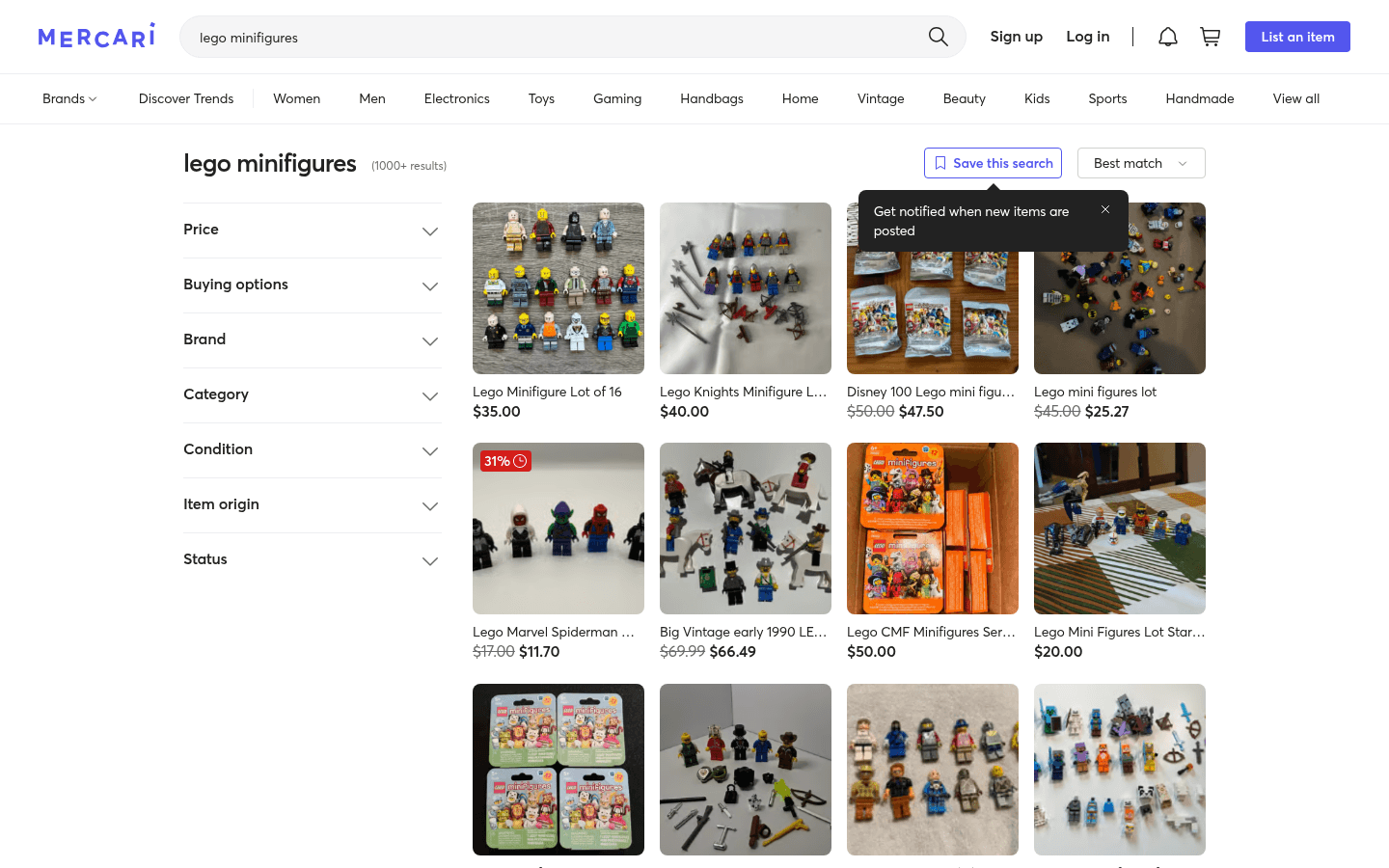
What Do These LEGO Selling Platforms Look Like?
Before choosing where to sell, it helps to see the difference between a live-selling marketplace, a broad search marketplace, a LEGO-native catalog, and a social or local channel. These screenshots are visual references only. Platform interfaces, fees, and rules can change.
CTA(Identify%20and%20Price%20100%2B%20Figures%20With%20One%20Pic).png)

