


A LEGO floor price is the lowest dollar amount you will accept for an item before you hold it, bundle it, or pull it from a sale, and setting one before you list on BrickLink, eBay, or Whatnot is what keeps a rough night of live selling from turning into a rough month of margins.
I've sold over $100k worth of LEGO on eBay, and the deals that actually hurt weren't the ones where I sold for less than I hoped. They were the ones where I never decided what "too low" meant before an offer showed up in my inbox or a lowball comment hit the stream. A floor price fixes that, whether you're pricing a single rare minifigure or clearing out a bulk lot you picked up on Facebook Marketplace.
- A floor price is the walk-away number you set before you list, not something you improvise during negotiation.
- Base it on real sold data from BrickLink, not on what other sellers are asking.
- Factor in platform fees, shipping, and your own time before you commit to a number.
- Minifigures, sealed sets, and bulk lots each need a different floor price approach.
- Revisit your floor prices every few months as sold data and demand shift.
What Is a LEGO Floor Price, Exactly?
A LEGO floor price is the minimum amount you will accept for an item, decided in advance and kept separate from your listed asking price. It is not the number you hope for. It is the number below which you would rather keep the piece, fold it into a bulk lot, or wait for a better buyer instead of taking the loss.
In my experience, most new sellers only think about the top of the range: what a minifigure or set could sell for on a great day. They rarely think about the bottom. That gap is where impulse discounts happen, and impulse discounts are how a good sourcing run turns into a break-even month.
Why Does a Floor Price Matter More on Whatnot and eBay Than on BrickLink?
A floor price matters most on platforms where buyers can pressure you in real time. On Whatnot, a chat full of lowball comments during a live show can push you into a price you will regret thirty seconds later. On eBay, a "best offer" can land at 2 a.m. when you are half awake and just want the notification to stop. BrickLink is calmer because it is mostly asking-price driven, but even there, a bulk store-acquisition offer can tempt you to sell below what your inventory is actually worth.
I use the same rule everywhere: if an offer is below my floor, I do not counter from a place of frustration. I say no, or I say "not at that price, but I could do X," and I move on. When I sell live on Whatnot, having that number already decided is the difference between a confident no and an awkward pause the whole chat can see.
In my experience, eBay is actually the platform where a floor matters least for speed and most for margin. If you list 30% to 50% below current market on a strong LEGO item, it will usually sell within 24 to 48 hours, no floor discipline required. The floor becomes important when you are not willing to discount that far, because that is exactly when a lowball offer shows up asking you to.
How Do You Calculate a Floor Price for a Minifigure?
To calculate a minifigure floor price, start with recent BrickLink sold prices for that exact figure and condition, subtract your estimated platform fees and shipping cost, then subtract a small amount for your own time. Whatever is left is roughly your floor. If that number feels too thin to bother with, that is useful information too.
I personally treat BrickLink sold data as close to the Wall Street of LEGO pricing. Asking prices are noisy, people list too high all the time, but sold data tells you what buyers actually paid. If you are building out a minifigure inventory, brick'em's LEGO minifigure database is a fast way to check a figure's identity and pricing context before you decide what you would walk away from.
A rough formula that has worked for me on individual figures:
| Step | What to subtract | Why it matters |
|---|---|---|
| Start | Recent BrickLink sold price (not asking price) | Sold data reflects what buyers actually pay |
| Subtract | Platform selling fees | Fees vary by platform and can swing your real take a lot |
| Subtract | Shipping cost you absorb, if any | Low-dollar items are especially sensitive to this |
| Subtract | A small time value for sorting, photographing, listing | Your time is part of the cost even if it feels free |
| Result | Your floor price | The number you will not go below without a real reason |
What's Different About Floor Prices for Sealed Sets?
Sealed sets need a higher floor relative to their cost than loose minifigures because box condition and completeness carry so much of the value. A dinged corner or a creased box can knock a chunk off what a collector will pay, so your floor should account for the fact that not every "sealed" listing photographs or sells like a mint one.
I rate sealed sets as underrated as a collector category. Box art, display value, and the general sense that a set has been performing well as a collectible all push demand higher than people expect. But I have also learned the hard way that a floor based on the best-case sold comp for a pristine box will bite you if your actual box has shelf wear. Price your floor off comps that match your real condition, not the best listing you can find.
How Should You Set a Floor for a Bulk Lot?
For bulk lots, set your floor on the lot as a whole first, then break it down by what you expect the highest-value pieces to be worth individually. Most bulk-lot profit comes from a handful of standout minifigures or parts, with the rest of the pile as a bonus, so your floor should assume you will find at least a few of those standouts.
My first Whatnot show only had about 10 people watching and still did over $500 in sales, and that early experience taught me the lot pieces I almost priced too low were the ones that ended up paying for the whole box. I started my own resale habit by buying discounted lots on Facebook Marketplace and sorting them at home. When I sort a new lot, I run the figures through brick'em's scanner first, because guessing at value before you know what you are holding is how sellers underprice an entire tote. If you want a sense of what a mixed collection might be worth before you commit to buying it, brick'em's LEGO collection value calculator is built for exactly that gut check.
How Do Platform Fees Change Your Real Floor Price?
Heads up: This is not financial or legal advice. We're sharing what we've learned from the LEGO reselling community.
Platform fees change your real floor price because the number a buyer pays and the number that lands in your account are not the same. eBay is the clearest example: if you need promoted listings to get eyeballs on a slower item, your total take rate can creep close to 25% of the sale once fees and promotion costs are combined, which means your floor needs to be higher than a quick mental-math number.
Here is how I think about the major platforms, based on what I have actually seen selling on them. Always check each platform's current fee schedule before you finalize a number, since fee structures do change.
| Platform | What I've noticed | Floor price impact |
|---|---|---|
| eBay | Reaches a huge audience, but promoted listings can push your effective take rate close to 25% on some sales | Build a bigger fee cushion into your floor |
| BrickLink | Generally cheaper selling fees, good for low-dollar individual parts and figures | You can often afford a lower floor here |
| Whatnot | Sometimes runs no-seller-fee days, which changes the math for that show only | Floor can flex lower on fee-free days |
| Facebook Marketplace | No platform selling fees, but you are trading that for local pickup logistics | Floor should reflect your time and travel, not just item value |
| Mercari | Another option worth comparing for lighter, easier-to-ship items | Compare fees against BrickLink and eBay before listing |
What Are the Most Common LEGO Floor Price Mistakes?
The most common floor price mistakes are pricing off asking prices instead of sold prices, forgetting fees entirely, and changing your floor mid-negotiation because a buyer sounds persuasive. I've made all three, usually in the same week when I was starting out.
- Using someone else's asking price as your floor instead of checking sold comps.
- Forgetting that promoted listings, shipping, and packaging all eat into your real floor.
- Caving on your floor because a buyer is friendly or a live chat is watching.
- Setting one floor for an entire bulk lot instead of pricing the standout pieces separately.
- Never revisiting old floors after the market moves, especially on themes tied to a show or movie.
A seller I know in the Whatnot space told me the fastest way to fix this is to write your floor down somewhere before the show starts, not decide it live. I've started doing the same thing, even for eBay offers. Having it written down removes the emotion from the moment.
How Often Should You Update Your Floor Prices?
You should revisit your floor prices every few months, and sooner for anything tied to an active show, movie release, or retiring set. Star Wars and Ninjago figures, for instance, can shift in demand quickly because both have ongoing story content feeding collector interest, while a theme like City tends to stay flat and low for a long time.
If you are tracking a growing collection or trying to decide whether to hold or sell, brick'em's LEGO investment calculator and haul calculator can help you see the bigger picture across your whole inventory instead of guessing item by item. I found that reviewing floors as a batch, rather than one listing at a time, catches drift a lot faster.
Frequently Asked Questions
Is a LEGO floor price the same thing as a reserve price?
Not exactly. A reserve price is usually a public or platform-enforced minimum in an auction format. A floor price is your own private number that guides whether you accept an offer, discount a lot, or walk away, and it applies to fixed-price and live-selling formats too, not just auctions.
Should I tell buyers what my floor price is?
Generally no. Sharing your floor removes your negotiating room and invites buyers to offer exactly that number every time. I keep my floor private and instead counter with a number above it, leaving room to land somewhere that still works for me.
What should I do if nothing meets my floor price?
Hold the item, fold it into a bulk lot, list it on a different platform with lower fees, or wait for a seasonal demand spike. I've held individual minifigures for months before the right buyer showed up, and it worked out better than discounting early.
Do floor prices work for individual LEGO parts too?
Yes, though the math shifts because individual parts are often low-dollar. BrickLink's cheaper selling fees make it easier to justify a low floor on parts under a few dollars, where eBay sellers often cannot justify the shipping cost at all.
Can a floor price change based on condition?
Definitely. A minifigure with paint wear or a set with a damaged box should have a lower floor than a mint comp, even if they are technically the same item. I always price my floor off comps that match the actual condition in front of me, not the best-case listing photo.
What Do These LEGO Selling Platforms Look Like?
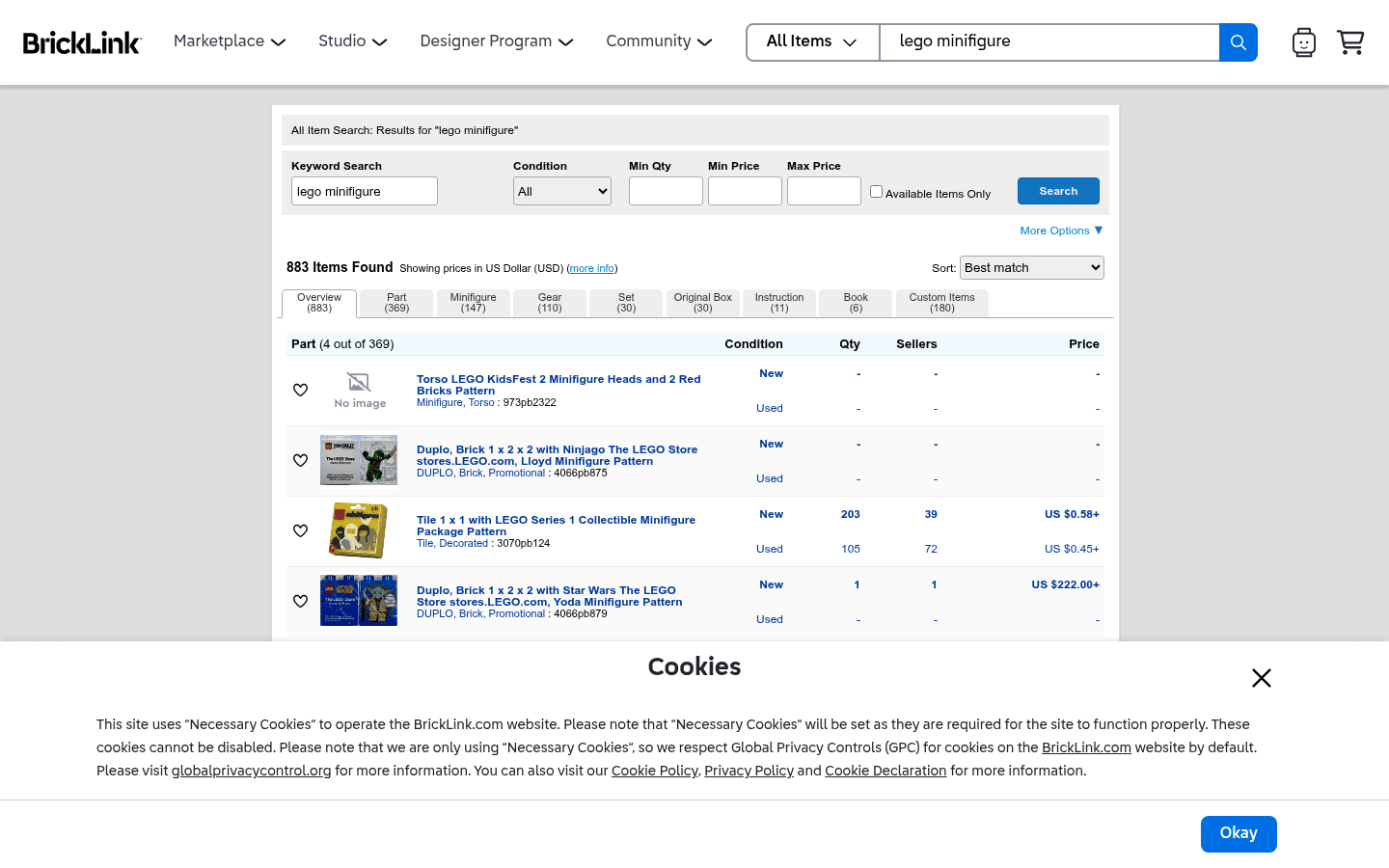
Before choosing where to sell, it helps to see the difference between a live-selling marketplace, a broad search marketplace, a LEGO-native catalog, and a social or local channel. These screenshots are visual references only. Platform interfaces, fees, and rules can change.
.png)

