

The LEGO minifigures that get misidentified most often are almost never the obvious rare ones. They're the common-looking variants: army builder troopers with a slightly different helmet print, torsos that got recolored across a few production years, and loose Collectible Minifigures separated from their packaging. If you sort bulk lots or bulk-buy from Facebook Marketplace and Whatnot, I'd bet you've priced at least one of these wrong without realizing it.
I've sorted thousands of minifigures while building brick'em, and the pattern holds up every time I look at a new batch. The figures that cause the most pricing mistakes aren't flashy. They're the ones that look 95% identical to a cheap variant and 5% identical to a figure worth ten times more. From what I've seen, that 5% is where resellers lose real money, one bin at a time.
- Printing and mold variants, not rarity alone, cause most misidentification.
- Army builder figures (troopers, soldiers, guards) are the single biggest confusion category.
- Loose Collectible Minifigures without packaging are hard to pin down by eye alone.
- Recolored torsos and legs across production years quietly change value.
- A scanner or catalog lookup beats guessing, especially on bulk lots.
Why Do So Many LEGO Minifigures Get Misidentified?
Most minifigures get misidentified because LEGO reuses molds and color palettes across hundreds of figures, so two figures from totally different sets can look nearly identical at a glance. Add in printing differences that changed mid production run, and even experienced sellers mix things up when they're moving through a big lot quickly.
LEGO has been producing the modern minifigure since 1978, and in that time the company has reused the same handful of head, torso, and leg molds across tens of thousands of figure combinations. In my experience, that reuse is the root cause of almost every identification mistake I see in reseller groups. A trooper from one wave can share 90% of its parts with a trooper from a completely different wave, and the only real difference is a printed stripe or a slightly different shade of gray.
When I started buying bulk lots for brick'em testing, I assumed rarity would be obvious. It almost never is. The figures that fooled me early on were the ones that looked "close enough" to a common variant, which is exactly when a reseller stops double checking and just prices by eye.
Which Minifigure Categories Cause the Most Confusion?
Army builder figures cause more misidentification than any other category, because LEGO intentionally produces many similar soldiers, troopers, and guards to fill out battle scenes. Star Wars clone troopers and battle droids are the classic example, but the same pattern shows up in Harry Potter robes, Marvel henchmen, and Ninjago ninja variants.
Star Wars is one of the most liquid themes a reseller can touch, which is exactly why getting the variant right matters so much. A plain clone trooper and a rare printed variant can share the same mold family, same basic colorway, and a totally different resale value. I recommend treating every army builder figure as a "check twice" category rather than assuming the common version by default.
Marvel is a good example of an underrated category where this bites resellers in the opposite direction. Because the market doesn't talk about Marvel variants as much as Star Wars ones, I've seen sellers underprice a legitimately scarce Marvel figure because they assumed, incorrectly, that it was the common run.
How Do Printing and Mold Variants Trip Up Resellers?
Printing variants trip up resellers because LEGO sometimes adjusts a figure's print detail, such as a face expression, belt design, or logo placement, partway through a production run without changing the set number or box art. The figure looks almost the same in a photo, but collectors and BrickLink buyers can tell the difference immediately.
This is where a lot of reseller pricing mistakes happen. A seller lists a figure using the first photo they find online, without confirming the exact print matches what's actually in their hand. I've made this mistake myself early on, pricing a figure based on a listing that turned out to be a different print variant entirely.
Mold variants are a second layer of the same problem. A leg piece, hand type, or head mold can be swapped across years for manufacturing reasons that have nothing to do with the character. Collectors care about these swaps. Casual sellers usually don't notice them at all.
Are Collectible Minifigures (CMF) Harder to Identify Than Other Figures?
Collectible Minifigures are generally easier to identify when they're still sealed in their packaging, since each bag and series has a known checklist, but they become much harder once they're loose. A loose CMF figure with no bag, no series info, and sometimes a swapped accessory is one of the toughest identification problems in the whole hobby.
The CMF line launched in 2010, and since then LEGO has released dozens of series, each with twelve or more figures that share a lot of visual DNA within the wave. Packaged CMFs hold a bit of mystery value, which is part of why collectors like buying them sealed. Once a figure is loose, that mystery becomes a liability for the reseller instead of an advantage for the buyer.
This is exactly the kind of situation where a scanning tool earns its keep. When I sort loose CMF figures, I don't try to eyeball which series or variant something came from. I check it against a catalog, because the visual differences between some series entries are genuinely subtle enough to fool a careful eye.
How Do Loose and Bulk Lots Make Misidentification Worse?
Bulk lots make misidentification worse because sellers are working through dozens or hundreds of figures at once, usually under time pressure, with no packaging and no accompanying set information to confirm what they're looking at. Speed is the enemy of accuracy here.
Buying bulk at a discount and flipping figures individually is one of the most common ways people build a LEGO reselling business, myself included. The profit is real, but it depends entirely on correctly identifying what's actually in the lot. A seller I know described going through a single garage-sale lot and finding that nearly a third of the figures weren't what they first assumed at a glance, once they actually checked each one piece by piece.
This is also where incomplete figures sneak in. A minifigure missing its original accessory or wearing a swapped leg piece can look like the wrong variant entirely, when really it just needs the correct part added back. Resellers who treat every odd-looking figure as "probably fake" or "probably common" leave money on the table.
What About Counterfeit and Bootleg Figures?
Counterfeit and bootleg figures add a separate layer of risk on top of normal printing and mold confusion, because a convincing bootleg can mimic an official print closely enough to pass a quick glance. The giveaways are usually in plastic quality, print sharpness, and stud markings, not the overall design.
I personally check stud markings and print clarity on anything that seems too good to be true for the price I paid. In my view, this matters more on individual high-value figures bought through casual channels like Facebook Marketplace or Instagram, where there's no marketplace buyer protection backing up the purchase the way there is on bigger platforms.
This isn't about assuming the worst on every figure. It's about applying extra scrutiny specifically to the figures where a wrong call costs the most, which brings us to the actual dollar impact.
How Much Can Misidentifying a Minifigure Cost a Reseller?
Heads up: This is not financial or legal advice. We're sharing what we've learned from the LEGO reselling community.
A single misidentified minifigure can cost anywhere from a few dollars to a significant chunk of a lot's total value, depending on whether the mistake is pricing a rare variant as common or the other way around. The bigger risk is usually underpricing, since an overpriced common figure just sits unsold while an underpriced rare one sells instantly and the mistake becomes permanent.
I've sold over $100,000 worth of LEGO through eBay over the years, and the pricing mistakes that actually hurt were never the big obvious ones. They were small misidentifications repeated across dozens of listings. One or two dollars lost per figure doesn't feel like much until you multiply it across an entire bulk lot.
| Misidentification Cause | Why It Happens | Typical Reseller Risk |
|---|---|---|
| Shared molds across waves | LEGO reuses head, torso, and leg pieces | Confusing a common figure with a scarcer one |
| Mid-run printing changes | Print detail adjusted without a new set number | Listing the wrong variant's price |
| Loose CMF figures | No bag, series checklist, or accessory context | Guessing the series or figure incorrectly |
| Bulk lot time pressure | Sorting dozens of figures quickly | Skipping a close visual check entirely |
| Bootlegs and counterfeits | Convincing copies of official prints | Paying full price for a fake |
How Can Resellers Reduce Misidentification Mistakes?
Resellers reduce misidentification mistakes by slowing down on anything that looks like an army builder, a loose CMF, or a figure they can't place immediately, and by checking it against a reliable catalog instead of pricing from memory. A quick verification step takes seconds and prevents the kind of mistake that compounds across a whole lot.
Here's the basic checklist I use when I'm sorting a new lot before anything gets priced or listed:
- Separate anything that looks like an army builder or background character for a closer look.
- Check print details (face, belt, logo) against the known variant, not just the overall color.
- Confirm loose CMF figures against the series checklist before assuming the common version.
- Inspect stud markings and plastic quality on any high-value figure bought outside major marketplaces.
- Run uncertain figures through a scanner or catalog lookup, like the one inside brick'em, before pricing them.
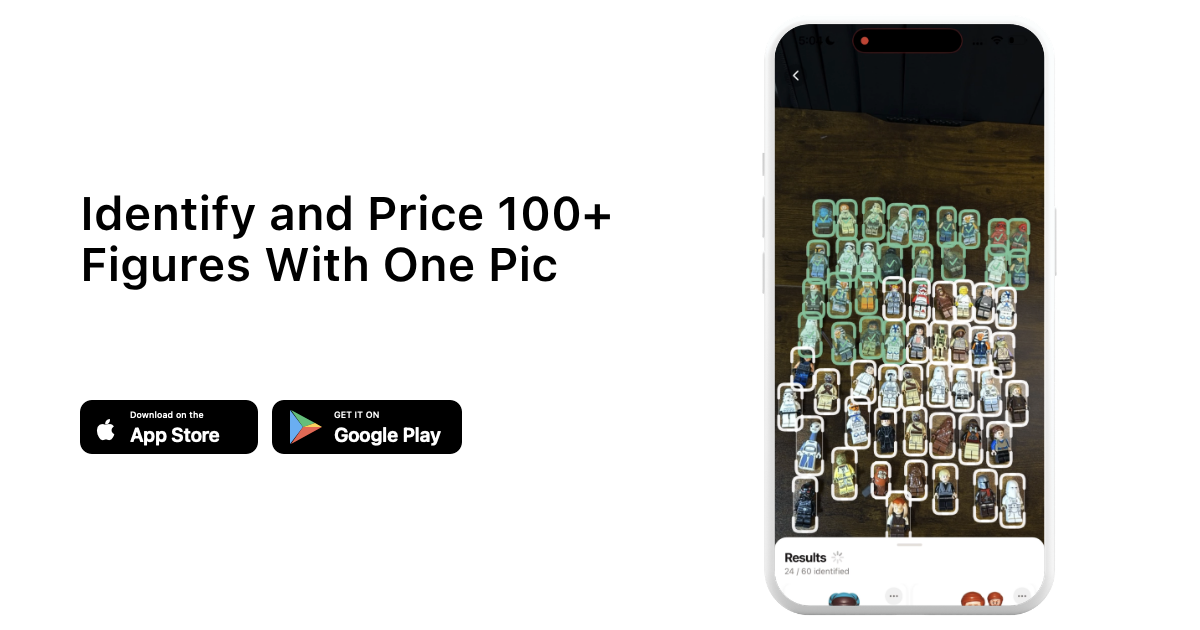
This is the exact workflow problem brick'em was built around. Instead of eyeballing a bin of 200 figures, you can scan them and get an identification and pricing reference back in bulk, which is a lot faster than searching each figure one at a time on a minifigure database. If you want to see how your own current inventory stacks up, running it through a collection value calculator is a good gut check before you commit to pricing an entire lot.
If you're buying lots regularly, it's also worth running the numbers before you buy, not just after. A haul calculator can tell you whether a lot is worth the asking price even before you've identified every individual figure inside it.
Frequently Asked Questions
What's the single most misidentified type of LEGO minifigure?
Army builder figures, like troopers, soldiers, and guards, cause the most confusion because LEGO produces many similar variants to fill out battle scenes. They often share molds and colors, with only a small print difference separating a common figure from a scarcer one, which makes quick visual pricing risky.
Are loose Collectible Minifigures harder to identify than packaged ones?
Yes. Packaged CMFs come with series and bag information that confirms exactly what you have. Once a figure is loose, that context disappears, and some entries within the same series look similar enough that even experienced sellers benefit from checking a catalog before pricing one.
Can a common-looking minifigure actually be a rare variant?
Yes, and this is one of the more expensive mistakes in reselling. Mid-run printing or mold changes can create a scarcer variant that looks almost identical to a common one. Underpricing it means it sells fast and the mistake becomes permanent, since you can't recover that lost value afterward.
How can I tell if a minifigure might be a bootleg?
Check plastic quality, print sharpness, and stud markings rather than just the overall design, since a convincing bootleg can mimic an official print at a glance. Extra scrutiny matters most on high-value figures bought through casual channels without marketplace buyer protection.
What's the fastest way to avoid pricing mistakes on a bulk lot?
Separate anything unfamiliar, especially army builders and loose CMFs, and verify it against a catalog instead of pricing from memory. Tools built for bulk scanning speed this up considerably compared to searching each figure individually, which matters once a lot has more than a handful of pieces.