

A LEGO investment portfolio strategy means spreading your money across different LEGO product types, themes, and price points instead of betting everything on one sealed set or one hot minifigure. In my experience, the resellers who build real staying power in this hobby are not the ones who get lucky on a single flip. They're the ones who treat their inventory like an actual portfolio, balancing fast moving categories against slower, higher ticket collector pieces so a quiet month in one lane does not sink the whole business.
I've spent years buying and selling LEGO across Whatnot, eBay, and BrickLink, and I've watched sellers make the same mistake over and over. They pour every dollar into whatever category just had a good week. That works until it does not. A diversified approach spreads your risk across liquidity, capital requirements, and theme popularity, so you are never fully exposed to one market swing. Think of it less like a single bet and more like running several small, complementary businesses under one roof.
- Diversify across product types: minifigures, sealed sets, bulk lots, parts, and modular builds all behave differently in how fast they sell and how much capital they tie up.
- Spread risk across themes too. Some, like Ninjago and Star Wars, move fast and sell to a broad buyer base. Others, like Harry Potter, move slowly and need the right platform.
- Match capital to liquidity. Modular buildings need more money up front but can pay off long term, while minifigures are cheap to enter and quick to turn over.
- Track everything in one place so you can see which part of your portfolio is actually earning and which part is just taking up shelf space.
What Does a Diversified LEGO Investment Portfolio Actually Look Like?
A diversified LEGO investment portfolio mixes several product types and themes instead of concentrating your cash in one category. In my experience that usually means holding a mix of minifigures, sealed sets, bulk lots, and a handful of higher capital pieces like modular buildings, spread across themes with different demand cycles and sell through speeds.
When I sort through a new haul, I am not just asking "is this worth money." I am asking where it fits in the bigger picture. Is it a fast mover I can flip for quick cash flow, or is it a slower, higher upside piece I should hold? A portfolio that only answers one of those questions is not really a portfolio, it is a pile.
Heads up: This is not financial or legal advice. We're sharing what we've learned from the LEGO reselling community.
How Should You Diversify Across LEGO Product Types?
You diversify across product types by combining categories that move at different speeds and require different amounts of money to get into. In my view, minifigures and bulk lots should make up the core of most portfolios because they are cheap to acquire and sell quickly, while sealed sets and modular builds act as the slower, higher ticket side of the business.
Minifigures are, in my view, the strongest all around category in the hobby. They are small, easy to store by the hundreds, and carry real story and character value on top of their plastic value. I have seen a figure about two thirds the size of an index finger sell for $2,000 to $3,000 because of who it represents, not what it is made of. That is a category worth building a real position in, and you can track your holdings against current market data with a LEGO minifigure database instead of guessing.
Sealed sets carry their own appeal. Part of it is the box art and display value, part of it is that sealed inventory tends to hold up better over time than opened sets. I will not tell you sealed LEGO beats stocks and bonds in every case, because that depends heavily on which set and when you bought it, but I do treat sealed sets as a legitimate long term holding inside a diversified portfolio rather than a quick flip.
Used and opened sets are the category I personally weight the lightest. From what I have seen, they generally do not appreciate the way sealed sets or minifigures can, so I treat them more as working capital than as the engine of the portfolio. Incomplete sets, on the other hand, are underrated. A seller I know regularly buys sets missing a handful of pieces at a discount, sources the missing parts through BrickLink, and resells complete sets for meaningfully more than the parts and purchase price combined.
Bulk lots deserve a real allocation too. They are a reseller favorite for a reason: someone clearing out a closet or flipping a garage sale find lists a mixed lot, you buy it at a discount, sort it, and sell the pieces individually for more than you paid for the whole lot. Individual parts round out the portfolio for sellers willing to do the sorting work, since parts and pieces are a genuinely massive market on their own.
Which LEGO Themes Deserve a Place in Your Portfolio?
Theme diversification matters because demand for LEGO is not evenly spread. Star Wars, Marvel, and Ninjago are, in my experience, the most liquid and beginner friendly themes, while categories like Harry Potter and City move much more slowly and need a different selling approach entirely.
| Theme | Liquidity | Best fit in a portfolio |
|---|---|---|
| Star Wars | High | Core, beginner friendly, sells almost everywhere |
| Ninjago | High | Core, ongoing show keeps demand active |
| Marvel | High, underrated | Core, big market that gets less attention than it deserves |
| Castle and Pirates | Moderate | Satellite, nostalgia buyers pay well on eBay and Whatnot |
| Modular buildings | High, but capital heavy | Satellite, long term collector anchor |
| Collectible Minifigures | High | Core, sealed packaging adds a mystery premium |
| Icons | Moderate | Satellite, display and decor buyers |
| Harry Potter | Low | Niche, best suited to BrickLink patience |
| City (minifigures) | Very low | Avoid as a core holding |
I will be blunt about two of these. City minifigures are, in my experience, highly illiquid and rarely sell for more than a couple dollars each, so I do not recommend building a position there. Harry Potter is overrated as a flipping category in my view. It is not very liquid and tends to sit, so when I do hold Harry Potter inventory I plan on BrickLink rather than a quick sale on a live platform.
On the other side, modular buildings are one of my favorite long term holds. They require real capital to get into, often hundreds of dollars per set, but I believe they will keep climbing as a collector category over time. Castle and Pirates sets are underrated for a similar reason. They pull in nostalgia driven collectors who will pay a premium, and I have found both themes do well on eBay and on Whatnot.
How Much Capital Do You Need to Start Diversifying?
You can start diversifying a LEGO portfolio with a surprisingly small amount of capital if you lean on low cost sourcing first. Facebook Marketplace listings, garage sales, and bulk lots let you build a base of minifigures and parts for relatively little money before you ever touch a higher capital category like modular sets.
I started the way most resellers do, buying cheap and reinvesting the profit. My first Whatnot show had only about 10 people watching and did a little over $500 in sales, which felt like real momentum at the time even though it was a small show by later standards. I used that early cash flow to slowly add higher ticket inventory instead of jumping straight into expensive sealed sets I could not yet afford to sit on.
A simple way to think about capital allocation as you grow:
- Start with bulk lots and loose minifigures, since they require the least cash per item and sell the fastest.
- Reinvest profit into a small number of sealed sets or collectible minifigure boxes once you have steady cash flow.
- Only add modular buildings or other high capital collector pieces once the rest of the portfolio is generating consistent turnover.
- Keep a cash buffer, since live selling platforms and marketplaces both have slow weeks.
How Do You Balance Liquidity Against Long Term Appreciation?
You balance liquidity against appreciation by keeping a core of fast selling inventory for cash flow while letting a smaller slice of slower, higher upside pieces appreciate in the background. In my experience, trying to do everything through quick flips burns you out, and trying to hold everything for appreciation leaves you cash poor.
eBay is where I lean for pure liquidity. In a strong niche like LEGO, if you list an item 30 to 50 percent below market value, I have found it is almost certain to sell within 24 to 48 hours. That speed comes at a cost, though. Promoted listings are often necessary to get enough eyeballs on a listing, and once you factor those in, your total eBay take rate can push close to 25 percent of the sale.
Whatnot sits on the other end of the spectrum for sellers who build an audience. Growth takes time, but I have personally gone from a 10 person show doing $500 to over 3,000 followers and more than $30,000 in sales within about five months, without ever showing my face on camera. That kind of growth is not guaranteed and it is not fast, which is exactly why Whatnot works best as the audience building layer of a portfolio rather than the only channel you rely on.
What's a Realistic Timeline for LEGO Investment Returns?
A realistic timeline for LEGO investment returns depends heavily on the category. Minifigures, bulk lots, and parts can turn over in days or weeks, while sealed sets and modular buildings are better thought of as multi year holds. I plan my own portfolio around that split rather than expecting every piece to pay off on the same schedule.
Early on, expect a learning curve. New sellers on Whatnot in particular should expect to lose a little money on some items during their first shows while they build a customer base and figure out pricing. I learned this the expensive way during my own first few months. The goal in year one is less about maximizing every sale and more about building the habits, audience, and inventory mix that compound later.
For longer holds like modular sets or rare sealed boxes, I recommend checking in on value periodically rather than obsessing over short term swings. A LEGO investment calculator can help you model how different categories might grow over a multi year timeline so your expectations stay grounded instead of based on one lucky sale you heard about.
How Do You Track a Diversified Portfolio Without Losing Your Mind?
You track a diversified LEGO portfolio by keeping every item, its source cost, and its current estimated value in one system instead of scattered across notebooks, spreadsheets, and memory. Once you are holding minifigures, sealed sets, bulk lot leftovers, and a few modular builds at the same time, guessing stops working.
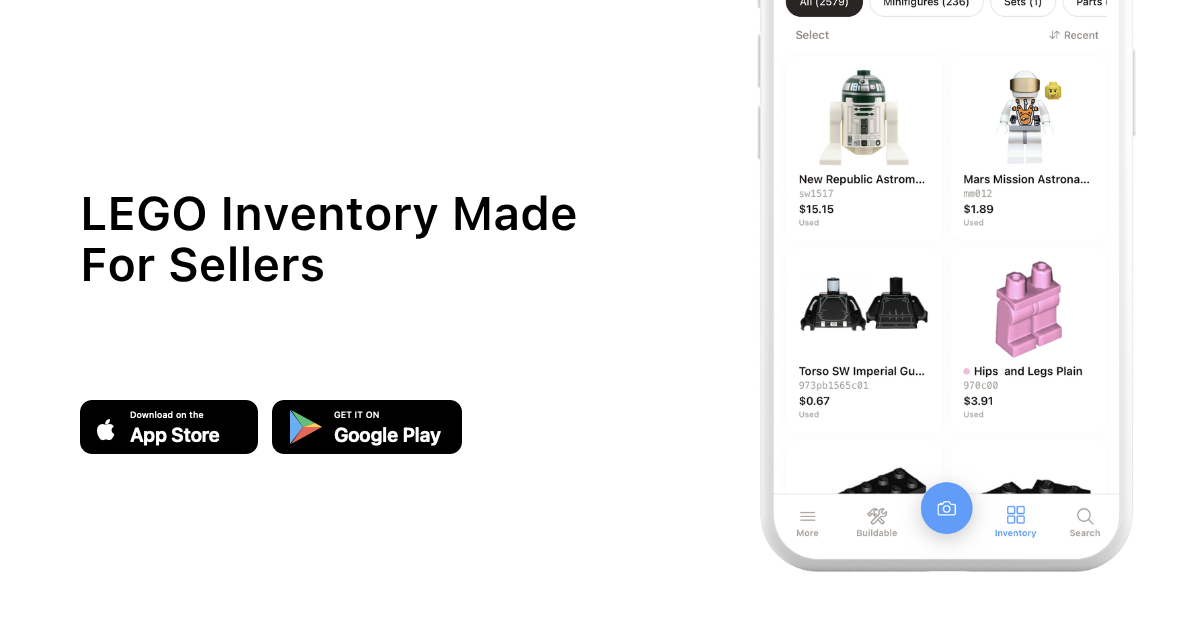
This is the part of the business I am most opinionated about, because I have seen too many sellers lose money simply from not knowing what they actually own. I use a LEGO collection value calculator to keep a running total of what my inventory is actually worth right now, not what I paid for it a year ago. When I am sorting a fresh bulk lot, I lean on tools that scan and identify minifigures in batches instead of looking each one up by hand, which is the single biggest time sink I had before I started doing this.
If you are just getting your systems in place, a free brick'em account gives you a central place to log inventory, pull pricing, and see your portfolio broken out by category instead of guessing from memory. It is also worth running your next big haul through a haul calculator before you buy, so you know roughly what a lot is worth before you commit capital to it.
What Mistakes Should You Avoid When Diversifying?
The biggest mistake I see is chasing whatever category just had a hot week and abandoning everything else. A close second is ignoring storage and overhead costs, like boxes, which look great for resale value but, in my experience, eat up space fast if you keep too many of them around the house.
- Do not put most of your capital into one theme, even a liquid one like Star Wars or Ninjago.
- Do not treat damaged or incomplete inventory as worthless. I have seen sellers restore and complete figures for well under what a clean example sells for.
- Do not ignore the real cost of promoted listings when you calculate eBay margins.
- Do not skip tracking. A portfolio you cannot measure is a portfolio you cannot manage.
- Do not expect every category to pay off on the same timeline. Bulk lots are fast money, modulars are patient money.
Frequently Asked Questions
What percentage of my LEGO portfolio should be minifigures?
There is no universal number, but in my experience a core allocation of roughly 30 to 40 percent in minifigures works well for most resellers because they are cheap to source, easy to store, and quick to sell. From there, adjust based on how much time you have to sort and identify figures versus hold slower sealed inventory.
Is LEGO really a better investment than stocks?
Some sealed sets have outperformed traditional assets over certain periods, but that is not a guarantee and it is not true of every set. I treat LEGO as a collectible with investment style upside rather than a replacement for a diversified financial portfolio, and I recommend treating any specific return claim with caution.
How long should I hold LEGO investments before selling?
It depends on the category. Minifigures, parts, and bulk lots often sell within days to weeks, while sealed sets and modular builds are better held for one to several years. I plan my own buying around that split so I always have cash moving while slower pieces appreciate.
Should beginners avoid any LEGO themes?
In my view, City minifigures are the one category new resellers should mostly avoid, since they rarely sell for more than a couple dollars each. Harry Potter is not worth avoiding entirely, but I would not build a beginner portfolio around it given how slowly it tends to move outside of BrickLink.
How much money do I need to start diversifying?
You can start with very little by sourcing bulk lots and loose minifigures from Facebook Marketplace or garage sales, then reinvesting profit as you go. I built my own portfolio this way before adding higher capital categories like modular sets once cash flow was steady.