

A standard LEGO minifigure is about 4 cm, or roughly 1.6 inches, tall from the bottom of its feet to the top of its head, not counting any hat, helmet, or hairpiece. Compared to an average adult human, that works out to something in the 1:35 to 1:48 range, though LEGO has never locked minifigures to one official engineering scale. The proportions are stylized on purpose: oversized round heads, short legs, and hook shaped hands that exist for playability and character, not realism.
I've spent years buying, sorting, and reselling minifigures, and the scale question comes up constantly from newer sellers who assume a bigger figure automatically means a rarer or more valuable one. It usually doesn't. In my experience, buyers care far more about the character, the print detail, and completeness than they do about exact millimeter measurements. Still, understanding how minifigure scale actually works helps you spot variants, price listings accurately, and avoid awkward mistakes in your photos and descriptions.
Key takeaways:
- Standard minifigures measure about 4 cm tall, excluding headgear and hair pieces
- The commonly cited 1:35 to 1:48 scale range is a rough comparison, not an official LEGO spec
- Microfigures, minifigures, and bigfigs are three distinct size classes with different proportions
- Scale rarely drives resale value on its own, character and condition matter far more
- Accurate measurements in your listings build buyer trust and cut down on returns
How Tall Is a Standard LEGO Minifigure?
A standard LEGO minifigure measures about 4 cm, or roughly 1.6 inches, from the soles of its feet to the top of its head. That figure excludes any hat, helmet, hairpiece, or accessory, which can add anywhere from a couple of millimeters to over a centimeter depending on the piece.
LEGO introduced the modern minifigure in 1978, and the core body height has stayed remarkably consistent since then. When I measure older figures against current ones, the leg and torso pieces line up almost exactly. Minor differences show up mostly in head shape, hand design, and printing detail, not in overall height. If you're trying to measure a figure yourself, stand it flat on a hard surface and measure straight up to the top of the head piece, ignoring any stud on top used for attaching accessories.
What Scale Are LEGO Minifigures Actually Built To?
LEGO has never published one official scale ratio for minifigures. The commonly cited range of 1:35 to 1:48 comes from hobbyists comparing minifigure height to average adult human height, and the exact ratio shifts depending on which reference height you use.
Scale modelers sometimes compare minifigures to military miniatures built at a true 1:35 or 1:48 scale, and the comparison is close but imperfect. LEGO sets themselves usually aren't built to one consistent architectural scale either. A LEGO City car or building is typically sized to look right next to a minifigure, not to match a real world blueprint ratio. That's why a LEGO house can feel oddly compact or a vehicle can feel oversized when you study it closely. The minifigure is the anchor, and everything else gets designed around it for playability first.
Why Minifigure Proportions Don't Match Real Scale Models
Minifigure proportions are intentionally exaggerated rather than true to human anatomy. The head is noticeably large relative to the body compared to a real person, the legs are short and stubby, and the hands are shaped like open hooks instead of five fingered hands.
I noticed this most clearly when I lined up a minifigure next to a 1:35 scale military figure from a hobby shop kit. The military figure's head, torso, and limbs were all proportioned closer to a real human body. The minifigure's head looked almost comically large by comparison. That's not a flaw, it's the design. The bigger head gives LEGO more surface area to print a face, and the simplified hands are built to grip LEGO pieces, tools, and accessories without snapping off during play.
Minifigure vs Microfigure vs Bigfig: How Do the Sizes Compare?
LEGO makes three main figure size classes with very different proportions. Microfigures are the smallest at around 1.5 cm, standard minifigures sit at about 4 cm, and bigfigs run roughly 8 to 10 cm depending on the character. Each size class serves a different purpose in LEGO's lineup.
| Figure Type | Approximate Height | Where You'll Find Them |
|---|---|---|
| Microfigure | About 1.5 cm (0.6 in) | Board games like LEGO Monopoly and some Heroica sets |
| Standard Minifigure | About 4 cm (1.6 in) | Most LEGO sets released since 1978 |
| Bigfig | Roughly 8 to 10 cm (3.1 to 3.9 in) | Oversized characters like trolls, ogres, and certain licensed sets |
Duplo figures are a separate line entirely, built at roughly double the size of a standard minifigure so toddlers can safely handle them. They aren't interchangeable with minifigure scale sets, and I wouldn't try to mix them in a listing or a display photo, because the size mismatch is obvious and can confuse buyers browsing quickly.
Does Minifigure Scale Affect Resale Value?
Scale and size rarely drive minifigure resale value on their own. In my experience, buyers pay for character popularity, print rarity, condition, and completeness long before they think about exact height or body proportions.
That said, size does matter in a couple of specific situations. Bigfigs and other oversized pieces can carry a premium simply because they're harder to find and cost more to produce, so when one shows up clean and complete, a seller I know will often price it well above a standard figure from the same set. On the flip side, I've seen brand new sellers assume a large head or unusual proportion automatically signals rarity, and that's rarely true. Checking a figure against the brick'em minifigure database before you price it is a faster way to confirm whether you actually have something unusual.
Rare, highly sought after minifigures can carry serious value regardless of their size. I've personally seen specific sought after figures trade in the $2,000 to $3,000 range in the secondhand community, though prices like that swing hard with condition, completeness, and current demand, so always check recently sold listings on BrickLink or eBay before you set a price.
Heads up: This is not financial or legal advice. We're sharing what we've learned from the LEGO reselling community.
If you're trying to figure out what your own collection might be worth before you list anything, running your numbers through a tool like the LEGO collection value calculator is a good gut check before you commit to pricing a whole lot.
How Has Minifigure Size Changed Since 1978?
Minifigure height has barely changed since the design launched in 1978. What has changed is detail: printing quality, joint articulation at the hips and hands, and the introduction of new head and hair molds over the decades.
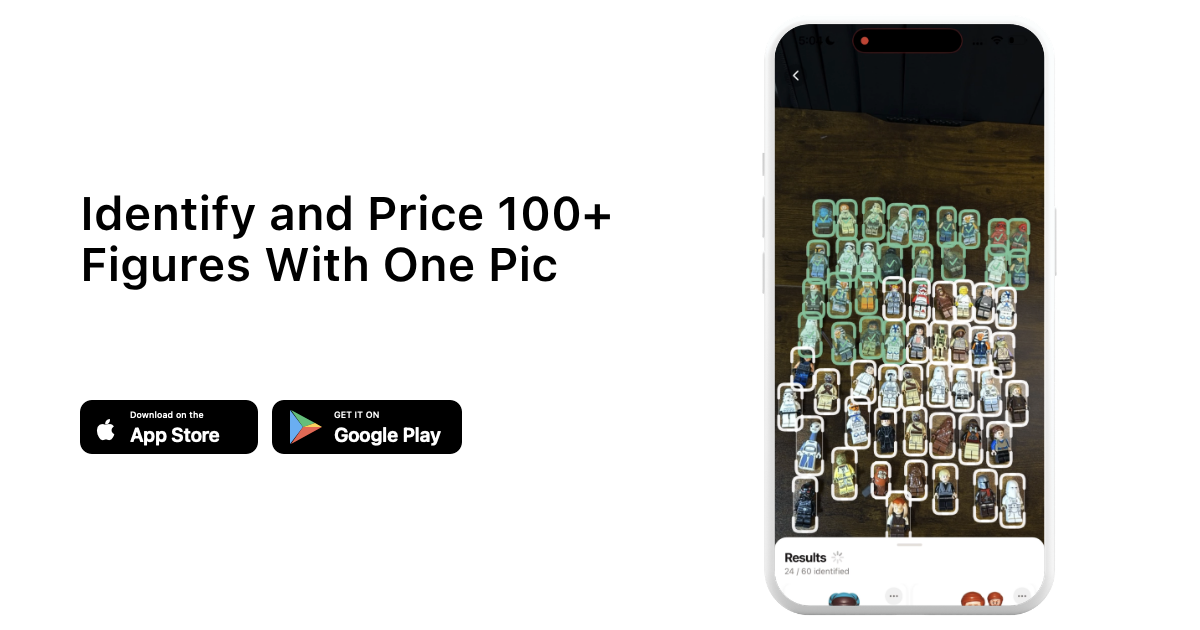
The biggest shift in variety, rather than size, came with the Collectible Minifigures line, which LEGO launched in 2010. That line kept the standard 4 cm body height but introduced far more unique torso, leg, and accessory combinations than general sets typically used. Packaged CMFs still lean on an element of mystery, since you can't see exactly which figure is inside until you open the bag, though scanning tools have made it much easier to identify opened figures quickly and accurately.
How Should Sellers Measure and Photograph Minifigures for Accurate Listings?
Accurate measurements and clean photos prevent returns and buyer disputes. A quick ruler check against the standard 4 cm height, combined with a straight on photo, gives buyers enough information to trust your listing without guessing.
I recommend building a simple routine before you ever list a figure. Here's the checklist I use when I sort through a new lot:
- Stand the figure upright on a flat surface before measuring
- Measure to the top of the head piece, not including any hat or hair
- Note any swapped parts separately from factory original parts
- Photograph the figure from the front and back in good, even lighting
- Flag any size oddities, like a bigfig or microfigure, clearly in the title
When I sort large bulk lots, I separate anything that doesn't match standard minifigure proportions right away, since bigfigs, microfigures, and Duplo pieces need their own listing category entirely. Mixing them into a general minifigure lot confuses buyers and usually drags down what the whole lot sells for.
Do Minifigure Proportions Vary Across Themes or Sets?
Minifigure height and core body proportions stay consistent across almost every theme, from Star Wars to City to Ninjago. Where you'll see small variation is in torso width, leg printing, and occasional stylized heads used for specific characters or promotional figures.
Some themed sets use slightly modified torso pieces to represent armor, capes, or bulkier clothing, which can make a figure look taller or wider in photos without actually changing the core height. I started paying close attention to this after getting a few buyer questions about why one figure in a themed set looked "bigger" than another from the same wave. It almost always came down to the accessory or printed design, not an actual change in body scale. If you want to dig deeper into specific theme variants and figure identification, the archive on the brick'em blog covers a lot of theme specific breakdowns.
Frequently Asked Questions
Are all LEGO minifigures exactly the same height?
Nearly all standard minifigures share the same core body height, about 4 cm from feet to head, since the design launched in 1978. Small visual differences usually come from hats, hair, or accessories, not from the actual body pieces being resized.
What is the scale ratio of a LEGO minifigure compared to a real person?
There's no official LEGO scale ratio, but hobbyists commonly estimate minifigures at around 1:35 to 1:48 when compared to average adult human height. The ratio shifts depending on which reference height you use, since minifigure proportions are stylized rather than anatomically accurate.
How tall is a LEGO bigfig compared to a standard minifigure?
Bigfigs typically stand around 8 to 10 cm tall, roughly double to two and a half times the height of a standard 4 cm minifigure. They're used for oversized characters like trolls and ogres where a regular minifigure body wouldn't look right.
Does minifigure size or scale affect how much it's worth?
Size alone rarely drives value. In my experience, character popularity, print rarity, and condition matter far more than whether a figure is slightly larger or smaller than standard. Oversized pieces like bigfigs can carry a premium mainly because they're less common, not because of size itself.