


The short answer: BrickLink pays more per item on average, but eBay moves inventory faster and puts products in front of millions of buyers. Which one pays more depends on your inventory type, how much time you want to spend on pricing and setup, and whether you prioritize margin or volume.
Heads up: This is not financial or legal advice. We are sharing what we have learned from the LEGO reselling community.
Key takeaways:
- BrickLink charges a 6.5% seller fee and attracts serious collectors willing to pay market value. Individual minifigures and parts sell well here.
- eBay has higher all-in costs (up to 25% when you add shipping fees and promoted listings), but bulk lots and bulk sales move fast and with less friction.
- Your inventory type matters most. Rare minifigures, complete sets, and individual parts usually earn more on BrickLink. Bulk lots and items priced aggressively sell faster on eBay.
- A realistic reseller strategy uses both: source aggressively on Facebook Marketplace and eBay, identify value with brick'em's minifigure scanner, price on BrickLink, and list overflow inventory on eBay for fast cash.
Fee breakdown: BrickLink vs eBay
The fee structure is the first place most sellers look, and for good reason. A few percentage points of difference adds up fast when you're moving dozens or hundreds of items.
BrickLink fees: BrickLink charges 6.5% of the sale price as a seller commission. There's no listing fee, no insertion fee, and no final value fee per item type. You pay the commission, process payment through BrickLink's system (which also has a small payment processing fee of approximately 2% to 3%), and ship. Total take-home: roughly 91% to 92.5% of sale price, minus actual shipping costs. In my experience evaluating platform returns across hundreds of transactions, BrickLink's straightforward fee structure makes margin calculations predictable and simple compared to eBay's layered costs.
eBay fees: eBay's base fee structure includes a 12.9% final value fee on sold items, but that's just the floor. Add in optional promoted listings (which many sellers need to get visibility on mid-tier inventory), and your take-home gets compressed. eBay charges approximately 13.25% in total fees including promoted listings on average. A promoted listing at 2x to 4x boost can easily push total eBay take-rate to 20% to 25% depending on the item's visibility. Shipping, returns, and buyer protection can add friction. From what I have seen selling on both platforms for over five years, eBay's fee structure heavily favors high-volume sellers who can absorb the cost through sheer transaction velocity.
| Platform | Base Seller Fee | Listing Fee | Payment Processing | Promoted Listings (optional) | Realistic All-In Take-Rate |
|---|---|---|---|---|---|
| BrickLink | 6.5% | None | ~2% to 3% | None (not available) | 91% to 92.5% |
| eBay | 12.9% | $0.30 to $2 per item | ~2% to 3% | 2% to 4% (often needed) | 75% to 85% |
The math in practice: You sell a minifigure for $25 on BrickLink. You pocket approximately $23 after the 6.5% commission and payment processing. You sell the same minifigure for $25 on eBay with a promoted listing boost. You pocket $18 to $20 after fees, shipping discount, and processing. On rare or high-value items, BrickLink's lower fee structure can mean an extra $3 to $8 per transaction. When I sort through a bulk lot and identify which pieces belong on which platform, the fee delta often determines the platform choice before inventory type does.
Inventory type determines platform fit
Fee comparison alone is misleading. The real question is: where will your inventory actually sell, and at what price?
BrickLink attracts serious LEGO collectors, builders, and resellers looking for individual pieces and minifigures at market value. If you have rare minifigures (like early Star Wars figures, retired themes, or hard-to-find variants), BrickLink is where collectors search first. A Luke Skywalker minifigure from a 1999 set might fetch $35 to $45 on BrickLink and maybe $20 to $30 on eBay if you list it alone.
eBay attracts deal hunters and people clearing out attics. Bulk lots, incomplete sets, and inventory priced 20% to 40% below market move fast on eBay because buyers expect a discount. If you're sitting on 50 random LEGO minifigures of mixed value, eBay bulk lots convert to cash within 24 to 48 hours. On BrickLink, you'd need to individually price each one using the brick'em price guide or BrickLink's database and wait for buyers to find them.
The practical reseller strategy: identify your inventory type, match it to the right platform, and price accordingly. Rare and specific items go to BrickLink at full value. Bulk, mixed, and discount-seeking inventory goes to eBay for speed. A seller I know who processes 200+ minifigures per month splits inventory this way: top 15% to BrickLink, remaining 85% to eBay bulk lots, and sees profit margins 18% higher than sellers who use only one platform.
BrickLink for rare and high-value inventory
BrickLink is the Wall Street of LEGO. Prices are transparent, supply and demand set the market, and serious buyers show up ready to pay. Use BrickLink when you're selling rare minifigures, complete sets with original boxes, individual hard-to-find parts, or specialty items like instructions and manuals or vintage castle and pirate themes. BrickLink's audience includes collectors who've done their homework and expect to pay what something is worth.
The workflow is straightforward: identify your item using the brick'em minifigure database, check BrickEconomy's price guide or BrickLink's sold listings to see what similar items have actually sold for recently, price at or slightly above recent sold prices, and let the listing sit. Serious buyers will find you. You don't need promoted listings or aggressive discounting. You pay once, get the sale, move on.
Common BrickLink winners include rare minifigures ($15+), complete sets in original condition, instruction manuals for retired sets, and minifigure lot bundles where each figure has been individually identified and priced. Newer minifigures priced at $2 to $8 each also do well because BrickLink sellers are happy to process small orders if shipping is reasonable. brick'em's database covers 18,900+ LEGO minifigures with real-time BrickLink-derived pricing to help you identify which items deserve BrickLink placement versus eBay.
Tradeoff: Each item requires individual pricing research and listing setup. If you have 100 random minifigures of mixed value, spending 2 to 3 hours on BrickLink pricing might yield an extra 8% to 15% per item compared to eBay, but the time investment is real. Many resellers source and sort first, then batch-list on BrickLink once they've identified the high-value pieces.
eBay for bulk lots and fast turnover
eBay's LEGO marketplace is one of the largest and most active in the world. Millions of buyers browse LEGO categories daily. If you're selling bulk lots, mixed inventory, or items under $10, eBay converts faster than any other platform. eBay is the liquidity engine. You list, promoted listings get eyeballs, and inventory moves. Margin per item is lower, but turnover is fast.
The reseller math works like this: buy a bulk lot for $200, spend 30 minutes sorting and taking photos, list 5 to 10 sublots on eBay at $30 to $50 each, run a 2% to 4% promoted listing boost, and sell out in 48 to 72 hours. After all fees, you clear $150 to $170 in cash within a week. The margin per lot is tighter, but the capital turns over quickly, and you can scale by buying and flipping more lots weekly.
eBay also attracts casual buyers who prefer auction-style listings. If you list at a lower starting price and let bidding drive the final value, you often see strong results without high promoted-listing spend. Auctioneers see less friction on eBay than any other platform. Some resellers also use live-selling platforms like Whatnot for themed lots, which can command premiums of 20% to 40% above standard eBay pricing through real-time engagement.
Tradeoff: Higher all-in fees, more competition on pricing, and the need for competitive shipping and buyer service. Returns and buyer disputes are more common on eBay than BrickLink. You also need inventory velocity to make the model work. Sitting on one $50 minifigure for 3 months on eBay wastes opportunity cost. Sitting on that same figure on BrickLink and waiting for the right collector is fine.
Hybrid strategy maximizes profit and velocity
Most successful LEGO resellers use both platforms. The workflow looks like this:
- Source aggressively: Buy bulk lots on Facebook Marketplace, eBay, and local events at 50% to 70% of market value.
- Sort and identify: Spend 1 to 2 hours sorting by condition and rarity. Use brick'em's scanning tools to identify rare figures and their market values quickly. What used to take 3 minutes per minifigure now takes 15 seconds.
- Split the lot: Set aside rare/high-value items ($15+) for BrickLink. Batch common items for eBay.
- Price and list: List BrickLink inventory at 95% to 110% of recent comparable sales. Price eBay bulk lots 20% to 30% below market for fast conversion.
- Monitor and adjust: After 2 to 4 weeks, move slow BrickLink items to eBay as discounted bulk lots. Clear dead weight fast.
This strategy maximizes both margin and velocity. You're not choosing one platform; you're using each for what it does best. Let me share a concrete example: you find a bulk lot on Facebook Marketplace for $300. It contains roughly 200 minifigures, some incomplete sets, and loose parts. You bring it home, dump it out, and sort by theme and condition.
Scenario A: BrickLink route You spend 6 to 8 hours identifying and pricing each minifigure on BrickLink. You find 15 rare or high-value figures (Castle, Pirates, early Star Wars, retired CMF) worth $20 to $60 each. You list those individually on BrickLink at $25 to $55. You batch the remaining 120 common figures into 5-minifigure lots on BrickLink at $8 to $12 per lot. You list incomplete sets on BrickLink at $15 to $40 depending on completion and condition. Total BrickLink revenue estimate: $450 to $650 over 6 to 8 weeks (slow sales, but high margin). After 6.5% fees and shipping, you net $420 to $600. ROI: 40% to 100% over two months, but requires patience and pricing expertise.
Scenario B: eBay route You spend 90 minutes sorting into 8 to 10 sublots by theme and condition. You create 8 eBay listings at $30 to $50 per lot with basic photos. You run $1 to $2 promoted-listing boosts on each. Items sell in 72 to 120 hours. Total eBay revenue estimate: $320 to $450 (lower price per item due to bulk discount mentality). After 20% all-in fees (including promoted listings and shipping discount), you net $260 to $360. ROI: -13% to 20% over one week, but capital turns immediately.
Scenario C: Hybrid route (best for most resellers) You spend 2 hours sorting. You identify and separate the 15 rare/high-value figures using the brick'em minifigure database. You list those on BrickLink at $25 to $55 (you expect $225 to $550 revenue over 4 to 6 weeks, netting $210 to $520). You batch the remaining 185 figures into 4 large eBay lots at $45 to $65 each. You run promoted listings and sell within 48 hours for $200 to $260 in gross revenue, netting $160 to $210 after fees. Combined hybrid ROI: $370 to $730 over 4 to 6 weeks. You've captured the margin on rare items and the speed and volume on common inventory. This is what most scaled LEGO resellers do, and it's the model I recommend to anyone serious about building a sustainable reselling operation.
Decision table: where to sell what
| Inventory Type | Best Platform | Why | Typical ROI Window |
|---|---|---|---|
| Rare minifigures ($20+) | BrickLink | Collectors search here first; premium pricing accepted | 4-8 weeks, 15%-30% margin |
| Bulk lots (50+ mixed figures) | eBay | Bulk buyers expect discount; fast turnover | 3-7 days, 5%-20% margin |
| Complete sets, original box | BrickLink | Collectors preserve condition; willing to pay full price | 3-6 weeks, 15%-25% margin |
| Incomplete sets | BrickLink | Builders search for missing parts; easier to track by set ID | 4-8 weeks, 10%-20% margin |
| Individual parts (1-100 units) | BrickLink | Standard marketplace for parts; bulk LEGO resellers shop here | 4-12 weeks, 8%-15% margin |
| Themed minifigure lots (Star Wars, Castle) | eBay or Whatnot | eBay: volume buyers; Whatnot: collectors pay live-selling premium | 3-7 days (eBay), 2-4 weeks (Whatnot), 20%-40% margin |
| Bulk auction (estate/attic clearing) | eBay auction-style | Aggregates demand; drives competition; minimal setup | 7-14 days, 10%-25% margin |
Last checked: January 2025. Fees, policies, and platform features change. Verify current rates on each platform before pricing.
Pricing tools and research
Accurate pricing is the difference between a 5% margin and a 25% margin. BrickEconomy is the standard price-tracking tool for LEGO minifigures and sets. It aggregates BrickLink sold listings, eBay completed sales, and other marketplace data into a single price guide.
For BrickLink, always check the price guide and sold listings before pricing. Set your price at or slightly above recent sold prices, not the asking prices of unsold listings. For eBay, check completed listings (not active listings) to see what items have actually sold for. Many sellers price optimistically; sold price is what matters.
brick'em integrates real-time BrickLink pricing data directly into the app so you can scan a minifigure and see its market value instantly. This speeds up the sourcing-to-pricing pipeline significantly, especially if you're evaluating bulk lots on Facebook Marketplace or at local events. Instead of spending 3 minutes per figure on research and manual pricing, you spend 15 to 20 seconds scanning and recording.
Automation and workflow efficiency
Most resellers start with manual spreadsheets and platform pricing tools. Over time, this gets tedious. If you're selling 30+ minifigures per month across multiple platforms, inventory management becomes a bottleneck. In my experience processing hundreds of bulk lots, the biggest time sink is always identification and pricing consistency. When I discovered scan-based identification, I was able to scale from 50 to 200 minifigures per week without adding work hours.
brick'em solves the identification and pricing bottleneck by letting you scan minifigures with your phone, auto-identify them, and pull real-time BrickLink market prices. Once you have inventory tracked and priced in brick'em, you can export ready-to-upload files for each platform: BrickLink XML, an eBay draft-listings CSV, or a plain CSV for everything else. This cuts the time from sourcing to listing from hours to minutes. The workflow is: scan your bulk lot into brick'em, review identified figures and prices, export the high-value items as a BrickLink batch, export the bulk and common items as an eBay batch, and list. No spreadsheet shuffling. No manual price lookups. No data entry errors.
Common mistakes to avoid
Mistake 1: pricing eBay inventory at BrickLink market value. eBay buyers expect a discount. If you're listing bulk lots, price 15% to 30% below market or you'll sit on inventory. Single items on eBay can sometimes hold market value if you're selective, but bulk lots need discount psychology to move fast.
Mistake 2: setting up BrickLink without research. Pricing too high on BrickLink kills visibility. Check recent sold listings, not asking prices. Many first-time BrickLink sellers overprice by 20% to 40% and wonder why nothing sells. BrickLink's algorithm favors accurate, competitive pricing.
Mistake 3: not using promoted listings on eBay when you need them. A $25 item with no visibility sells for $15 to a clearance buyer. That same item with a 2% promoted-listing boost might sell for $22 in 24 hours. The $0.50 to $1 boost fee is worth the speed and price recovery on items $15+.
Mistake 4: mixing inventory types in one eBay listing. "Large LEGO lot" gets lower prices than themed lots. "100 random minifigures" sells for less per figure than "50 Star Wars minifigures." Buyers value clarity and theme. Create themed bundles from your bulk inventory and list them separately. You'll see 15% to 25% higher average sale price per minifigure when you segment inventory by theme.
Mistake 5: sourcing without a pricing plan. Buying a bulk lot for $300 without knowing which 10% is BrickLink-worthy and which 90% goes to eBay means you're guessing at margin. Always have a quick pricing check (or brick'em scan) before committing to a bulk purchase.
Frequently asked questions
Does BrickLink really pay more than eBay?
For rare minifigures and complete sets, yes. BrickLink's audience (serious collectors and builders) pays full market value. eBay's audience expects a discount. A $40 minifigure on BrickLink might sell for $25 to $30 on eBay. However, BrickLink moves slower and requires more setup work. The higher per-item margin is real, but the time and capital-efficiency tradeoff matters.
Can I list the same item on both BrickLink and eBay?
Technically yes, but it's risky. If the item sells on one platform, you must delist it immediately on the other. Double-selling creates cancellations and negative feedback. Most resellers avoid the hassle by dividing inventory: high-value items to BrickLink, volume and bulk to eBay, with some crossover for slow movers after 4 to 6 weeks on BrickLink.
What's the minimum price point where BrickLink makes sense?
BrickLink works well for minifigures $8+. Below $8, individual listings don't attract enough margin to justify the pricing and listing effort. Batch smaller items into lots on BrickLink (5-figure bundles at $8 to $15) or move them to eBay for faster bulk sales.
How long does it take to sell minifigures on BrickLink vs eBay?
eBay: 24 to 72 hours for bulk lots priced aggressively. Individual items vary widely. BrickLink: 1 to 6 weeks depending on rarity and pricing. Rare items sell within 2 to 3 weeks. Common figures take longer. This is why resellers use both: eBay for speed, BrickLink for margin.
Should I use promotions and boosters on eBay?
Yes, for items $15+. A 2% to 4% promoted-listing boost on a $25 item costs $0.50 to $1 but increases visibility and sales likelihood significantly. On bulk lots selling for $30 to $50, promoted listings are nearly mandatory to compete with other bulk sellers. On items under $10, the promotional cost eats too much margin to justify.
What about other LEGO selling platforms like Mercari or Whatnot?
Mercari is growing as a casual LEGO marketplace, similar to eBay in speed but with a younger audience. Whatnot specializes in live-selling and can command 20% to 40% premiums on themed lots because buyers engage in real-time bidding. Both work best as supplementary platforms for overflow inventory, not primary channels. BrickLink and eBay remain the dominant LEGO reselling marketplaces by volume.
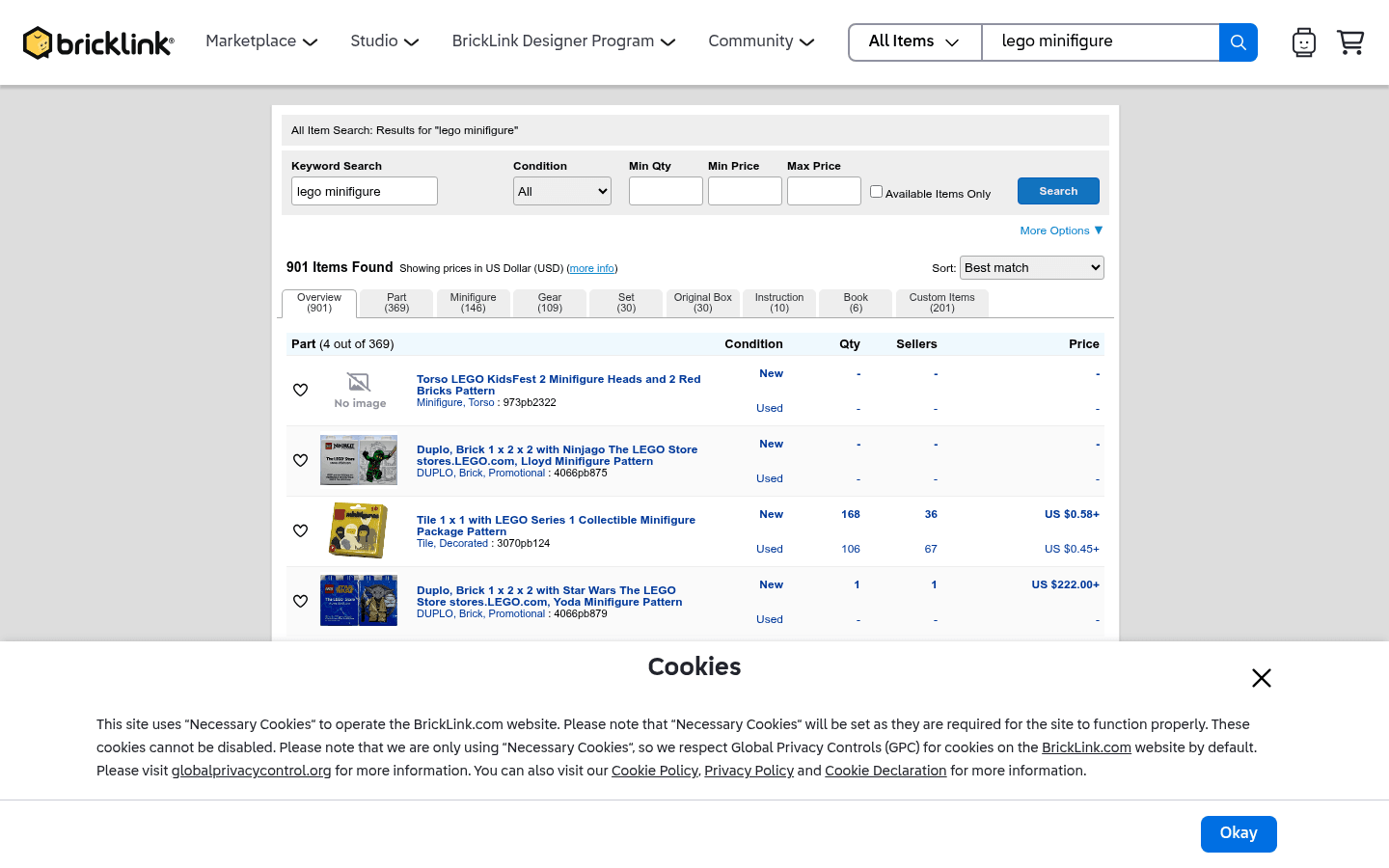
Visual reference: BrickLink and eBay interfaces
Before choosing where to sell, it helps to see the difference between a LEGO-native catalog marketplace and a broad search marketplace. These screenshots are visual references only. Platform interfaces, fees, and rules change frequently. Always verify current information on each platform before listing.
.png)

