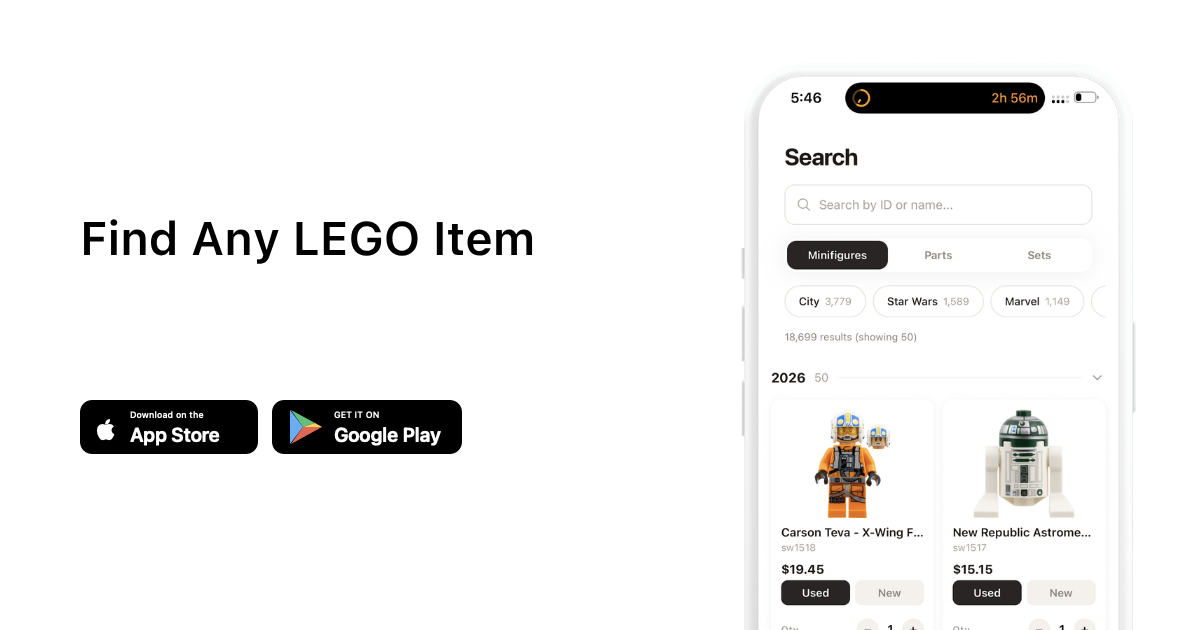


The LEGO resale market is not a corner of eBay where a few collectors trade figures back and forth. It is a structured industry with franchise chains, dedicated marketplaces, live-selling platforms, and millions of dollars changing hands every single day.
Heads up: This is not financial or legal advice. We're sharing what we've learned from the LEGO reselling community. Your situation may be different. Talk to a professional if you need specific guidance.
If you are trying to understand the actual size and shape of this market, whether you are considering getting into LEGO reselling, researching the collectibles space, or just curious how plastic figures generate this kind of revenue, here is what the data shows.
What Is the LEGO Resale Market Worth?
In 2024, WILCO Toys estimated the total independent LEGO resale and events market at $705 million USD. WILCO tracked $140 million in historical market sales in the first half of 2024 alone (across eBay and BrickLink combined), then projected the full-year figure based on seasonal patterns and additional market segments.
That $705 million includes:
- Online marketplace sales (BrickLink, eBay, Mercari, Whatnot)
- Physical LEGO resale stores (franchise and independent)
- LEGO conventions and events
- Live-selling platforms
It does not include private sales through Facebook Marketplace, local cash transactions, or international markets that are difficult to track. The real number is likely significantly higher.
Why $705 Million Feels Low (And Probably Is)
The LEGO Group reported approximately $13 billion in primary retail revenue in 2025 (a 12% increase year over year, per CNBC). How is it possible that an entire secondary market is only worth 5% of what LEGO does in new sales every year?
The short answer: $705 million is almost certainly an undercount. WILCO tracks what is trackable. That means completed sales on eBay and BrickLink, reported franchise revenue, and event sales with paper trails. It does not capture:
- Cash transactions at garage sales, estate sales, and flea markets
- Facebook Marketplace and Craigslist sales (no centralized reporting)
- Private collection sales between individuals
- International markets in Asia and the Middle East where LEGO collecting is exploding
- Whatnot and other live platforms that do not break out LEGO-specific revenue
Consider just one data point: Whatnot facilitated over $8 billion in total live sales in 2025. LEGO is one of their top toys categories. Even if LEGO represents just 3 to 5% of Whatnot volume, that alone would be $240 to $400 million in LEGO sales through a single platform that barely existed three years ago.
The real LEGO secondary market is likely well north of $1 billion annually. The $705 million figure is the conservative, trackable floor.
eBay: The Largest Single Platform for LEGO Resale
eBay is almost certainly the single largest platform for LEGO resale by dollar volume. WILCO's $140 million in tracked H1 2024 sales came from eBay and BrickLink combined, with eBay accounting for the majority due to its sheer traffic volume and higher average transaction values on complete sets.
LEGO consistently ranks as one of eBay's top-performing toy categories. The platform's auction format drives competitive bidding on retired sets, often pushing final prices well above fixed-price market value. Star Wars, Harry Potter, and Creator Expert sets are the strongest performers. Individual rare minifigures and sealed retirement-era sets regularly sell for $100 to $500+ through eBay auctions.
The tradeoff is fees. eBay charges approximately 13.25% plus $0.30 to $0.40 per order. On a $200 sale, that is roughly $27 gone to eBay. Many high-volume sellers use eBay for their most valuable items (where the traffic justifies the fee) and sell everything else through lower-fee platforms like BrickLink.
The Study That Went Viral
In 2021, a peer-reviewed study by Victoria Dobrynskaya at HSE University made international headlines. The research analyzed 2,322 LEGO sets from 1987 to 2015 and found they appreciated by an average of 11% annually, outperforming large-cap stocks, bonds, gold, and most alternative investments over the same period.
The study was published in Research in International Business and Finance. Then it went viral. The Hill, CNBC, The Manual, Yahoo Finance, and dozens of other outlets picked it up. The headline was irresistible: "Investing in LEGOs is better than gold."
That single study shifted how the world talked about LEGO. It legitimized what thousands of resellers already knew from experience. It turned "I sell LEGO" from something people said apologetically into something that sounded like a smart financial move. It stirred opinions across the globe about this "passion market" being a genuine wealth-building vehicle.
And the numbers backed it up. A more recent analysis by Brickfact found an average annual return of 15.63% from 2011 to 2023. Not every set. Not guaranteed. But as an asset class, LEGO was producing returns that most stock portfolios would envy.
Since that study went viral, the LEGO resale community has exploded. What was once a quiet corner of the internet became a recognized market with thousands of people building life-changing income. Full-time resellers. Franchise owners. Live-stream sellers. People who quit their day jobs because the math worked better than their salary.
How Fast Is the Market Growing?
Look at this Google Trends chart for "lego investing" in the United States over the past five years:
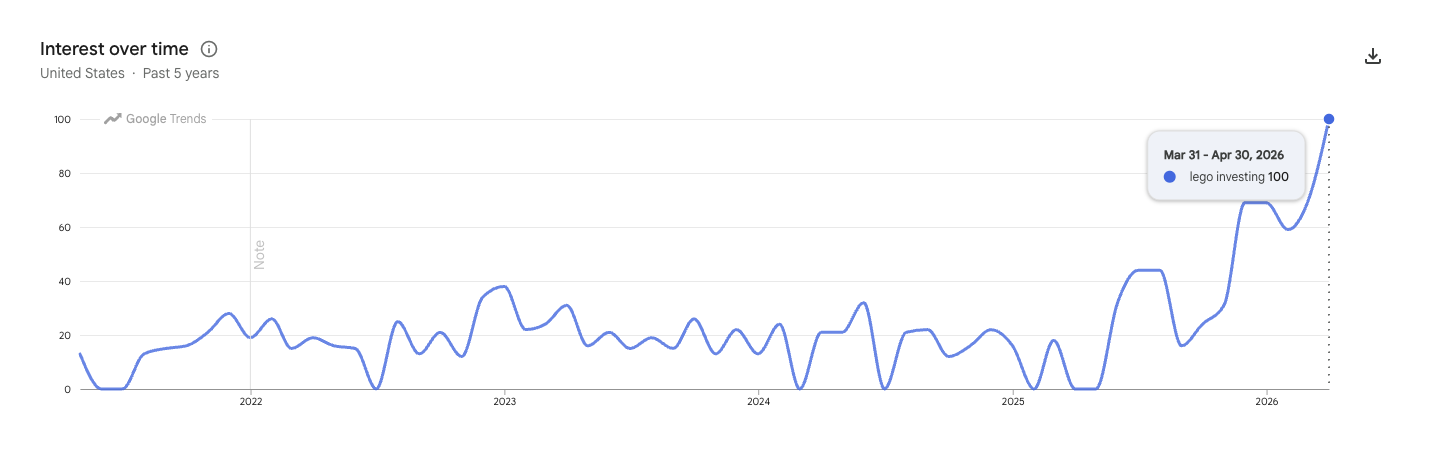
Search interest hovered between 20 and 40 from 2021 through mid-2025. Then it spiked to an all-time high of 100 in early 2026. That is not a gradual climb. That is a market waking up.
There is no single compound annual growth rate published for the LEGO secondary market specifically. But every proxy indicator points in the same direction:
- Bricks & Minifigs (the largest LEGO resale franchise) grew from 35 locations in 2018 to over 300 in 2025. They doubled from 150 to 300 stores in under two years. Systemwide revenue exceeded $95 million in 2025.
- Whatnot (live-selling platform where LEGO is a top toys category) went from $3 billion in total platform sales in 2024 to over $8 billion in 2025.
- LEGO Group revenue grew 12% in 2025. Every set produced today will retire within 1 to 3 years and enter the secondary market as the sole remaining supply.
- BrickLink (world's largest dedicated LEGO marketplace) has approximately 19,000 active sellers across 70+ countries, with over 1 million registered members since its founding in 2000.
The structural dynamic is straightforward. LEGO produces more sets each year. All of them eventually retire. Once retired, supply is fixed while demand continues. This creates a one-directional supply squeeze that has fueled secondary market growth for over two decades.
And like any maturing market, sellers are finding their niches. This is not one monolithic business model. The LEGO resale economy has developed distinct channels:
- B2B / Wholesale: Sellers who buy bulk and supply other resellers, stores, or live-stream sellers with sorted inventory at volume pricing.
- D2C (Direct to Collector): Individual sellers listing on BrickLink or eBay, selling directly to the end buyer. Highest margins, most time per transaction.
- Live Streams: Whatnot and YouTube sellers running real-time auctions. Entertainment-driven, impulse-purchase-heavy, high volume per session.
- Storefronts: Bricks & Minifigs franchises and 200+ independent stores buying collections locally and selling to walk-in customers.
- Hybrid operators: The growing segment of sellers who source from one channel and distribute across several. Buy bulk lots locally, part out the high-value figures for BrickLink, sell mid-tier items on eBay, move the rest on Whatnot streams, and dump the commons at wholesale.
The market has enough depth now that sellers specialize. Some only do Star Wars. Some only do CMFs (Collectible Minifigure Series). Some focus entirely on parts. The niche you pick determines your sourcing strategy, your platform mix, and your margin profile.
Who Are the Major Players?
BrickLink
The world's largest dedicated LEGO marketplace. Approximately 19,000 active sellers and over 1 million registered members across 70+ countries. Founded in 2000 by Dan Jezek, acquired by the LEGO Group in 2019. Charges a flat 3% seller fee (significantly lower than eBay's ~13.25%). Specializes in individual parts, minifigures, and rare pieces. The platform where serious collectors go to find specific items.
Note: In late 2025, BrickLink suspended marketplace operations in 35 countries due to local tax compliance requirements. The core markets (US, UK, EU) remain active.
Bricks & Minifigs
The largest LEGO resale franchise chain. 300+ retail locations as of early 2026. Systemwide revenue exceeded $95 million in 2025. Individual stores generate $300,000 to $1.2 million in annual revenue. Average quarterly sales per franchisee reached $121,000 as of mid-2025 (up from $50,000 when the current ownership took over in 2018). Initial franchise cost: $241,000 to $570,000.
eBay
The largest general marketplace for LEGO resale by traffic and likely by total dollar volume. WILCO's tracked data shows eBay and BrickLink combined generated $140 million in LEGO sales in H1 2024, with eBay carrying the larger share. Charges approximately 13.25% in fees plus $0.30 to $0.40 per order. Strongest for complete sets, especially popular retired themes where competitive bidding drives prices above fixed-price listings.
Whatnot
The dominant live-selling platform. Facilitated over $8 billion in total live sales in 2025 across all categories. Ranked as the #1 Shopping app in both the US and UK in 2025. Generated $100 million+ in live sales on Black Friday 2025 alone. LEGO is one of the strongest categories in their Toys and Hobbies vertical.
Independent Stores
WILCO tracks over 200 independent LEGO stores (often called Brick Stores) outside of the Bricks & Minifigs franchise. These stores generate anywhere from $300,000 to $1.2 million per year and serve local communities by buying collections and selling sorted inventory.
Individual Online Sellers
The largest segment by headcount. Thousands of individual sellers operate across eBay, BrickLink, Mercari, Facebook Marketplace, and Whatnot. Revenue ranges from a few hundred dollars monthly (casual side sellers) to $150,000+ annually (full-time operators with inventory systems and multi-platform strategies).
The common thread across every channel is sourcing. Sellers buy minifigures in bulk off Facebook Marketplace, eBay, garage sales, and estate sales. The challenge is always the same: you are staring at a pile of figures and you need to know what they are worth before you buy, or immediately after.
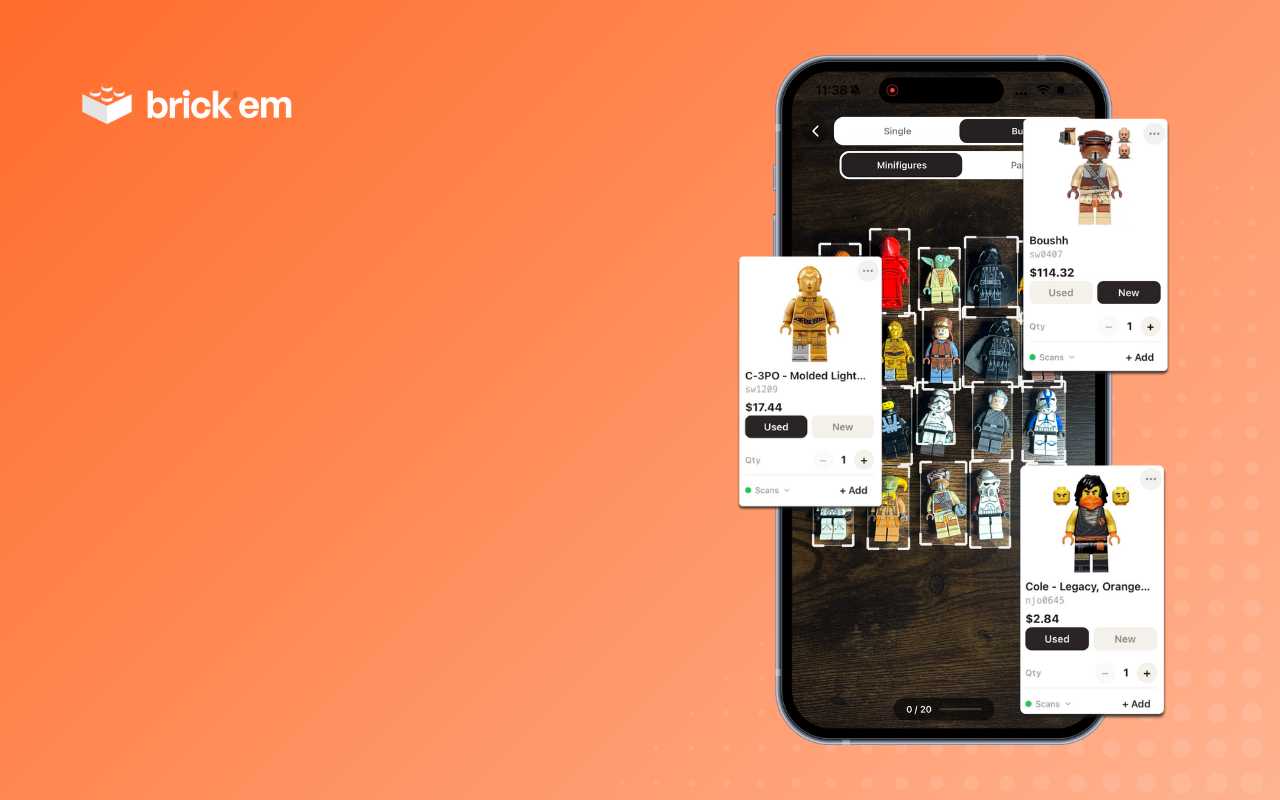
brick'em tip: Snap one photo of an entire lot and brick'em identifies every minifigure in the image. 20+ figures scanned at once, each matched against 18,900+ in the database with live BrickLink prices. You see the total market value of the whole lot instantly, not one figure at a time. Try it free.
What Makes Up the Market?
The LEGO resale market is not just people flipping sealed boxes. According to data from Upright Labs, approximately 30% of the secondary market is new-in-box set flipping. The remaining 70% is driven by:
- Used sets (complete or near-complete, sold as-is or rebuilt)
- Individual minifigures (the highest margin category, especially rare or exclusive figures). Accessories matter too. Weapons, headgear, and capes and cloth pieces can be worth more than the figure itself.
- Individual parts and pieces (specific colors, prints, and rare elements). Some of the most expensive LEGO pieces ever sold are individual parts, not full sets. Rare colors, chrome gold elements, and printed tiles all have dedicated collector markets.
- Bulk lots (unsorted LEGO sold by weight, typically $5 to $10 per pound). Knowing what red flags to watch for and how to properly evaluate a bulk lot is critical for sourcing profitably.
- Instructions and packaging (collectors pay for complete original presentation)
Minifigures are the most liquid and highest-margin segment. A single rare minifigure can be worth more than the entire set it came from. This is where scanning and identification tools provide the most value, because the difference between a $3 common figure and a $150 rare variant is often invisible to the untrained eye.
Platform Fee Comparison
| Platform | Seller fees | Best for |
|---|---|---|
| BrickLink | 3% flat | Individual parts, minifigures, serious collectors |
| eBay | ~13.25% + $0.30-$0.40/order | Complete sets, high-traffic auctions |
| Mercari | 10% | Casual buyers, simple listings |
| Whatnot | Varies (seller tier) | Live selling, volume, impulse buyers |
| Facebook Marketplace | 0% (local) | Bulk lots, local pickup, heavy items |
Most successful resellers use multiple platforms simultaneously. Different items perform better on different channels. A minifigure that sits for weeks on BrickLink might sell in seconds during a Whatnot stream. A heavy bulk lot that is expensive to ship sells same-day on Facebook Marketplace for local pickup.
Frequently Asked Questions
How much is the LEGO secondary market worth?
WILCO Toys estimated the independent LEGO resale market at $705 million USD in 2024, though the real figure is likely over $1 billion when accounting for untracked private sales, Facebook Marketplace, and live-selling platforms that do not report LEGO-specific revenue.
Is the LEGO resale market growing?
All available indicators suggest yes. Bricks & Minifigs doubled their store count in two years. Whatnot's total sales more than doubled from 2024 to 2025. LEGO Group revenue grew 12% in 2025, meaning more sets will eventually enter the secondary market upon retirement.
What percentage of LEGO resale is minifigures vs sets?
Approximately 30% of the secondary market is new-in-box set flipping. The remaining 70% is used sets, individual minifigures, parts, bulk lots, and accessories. Minifigures are the highest-margin category for individual sellers.
How many sellers are on BrickLink?
BrickLink has approximately 19,000 active sellers and over 1 million registered members across 70+ countries. It is the world's largest dedicated LEGO marketplace with the lowest fees of any major platform at 3%.
Where can I check LEGO resale prices?
BrickLink provides historical sale data. BrickEconomy tracks price trends and appreciation. brick'em pulls live BrickLink pricing automatically when you scan a figure, so you do not need to look anything up manually.
What LEGO themes have the best resale value?
Star Wars, Harry Potter, Creator Expert/Icons, and Marvel consistently outperform other themes on the secondary market. Limited-run licensed sets and sets with exclusive minifigures appreciate the most after retirement. Ninjago and City have lower per-set value but high volume.
Is LEGO reselling legal?
Yes. Reselling LEGO is completely legal under the first-sale doctrine. Once you buy a product, you can resell it. Thousands of sellers operate openly on eBay, BrickLink, and through franchise stores like Bricks & Minifigs. You may need a business license and to collect sales tax depending on your state.
Where do LEGO resellers find inventory?
The most common sourcing channels are garage sales, estate sales, Facebook Marketplace, Goodwill bins, thrift stores, eBay bulk lots, LEGO conventions, and retail clearance. Sourcing is the core skill that separates profitable resellers from everyone else.
Ready to start selling? brick'em scans your minifigures, pulls accurate BrickLink prices, and manages your inventory across collections. Stop spending hours on manual lookups. Start your free trial.
Sources
- WILCO Toys. "Market research and sales data for the LEGO economy." wilcotoys.com/economics-of-lego (2024 market estimate: $705M, $140M tracked in H1 2024 across eBay + BrickLink, 200+ independent stores)
- CNBC. "Lego 2025 earnings: How the company keeps beating the toy industry." March 2026. ($13B revenue, 12% YoY growth)
- Bricks & Minifigs. "Surpasses 300th Store, Doubling Growth in Just 2 Years." January 2026. (300+ locations, $95M systemwide revenue, $121K avg quarterly sales per franchisee)
- Whatnot / Sacra. Revenue and platform data. sacra.com/c/whatnot ($8B+ total sales 2025, #1 shopping app US/UK)
- Dobrynskaya, V. & Kishilova, J. "LEGO: The Toy of Smart Investors." Research in International Business and Finance, 2021. (11% annual returns, 1987-2015, 2,322 sets analyzed)
- Brickfact. "Better returns with LEGO than with gold and shares." brickfact.com (15.63% annual returns, 2011-2023)
- Upright Labs. "Why LEGO Dominates the Online Resale Market." uprightlabs.com, March 2025. (30/70 market split, platform data)
- The Hill. "Surprising new study finds investing in Legos better than gold, stocks, bonds and art." 2021. (Viral coverage of HSE study)
- BrickLink / Wikipedia. Platform history, membership data, fee structure.
- Retail TouchPoints / Franchise Times. Bricks & Minifigs franchise reporting. (Store count, revenue per location, growth timeline)
Note: The LEGO resale market lacks a single authoritative data source. The $705M figure is an industry estimate from WILCO Toys based on tracked sales and projections. The actual market is likely larger when accounting for untracked channels. Platform revenue figures are self-reported or from third-party analysts. Historical return data reflects past performance and does not guarantee future results.