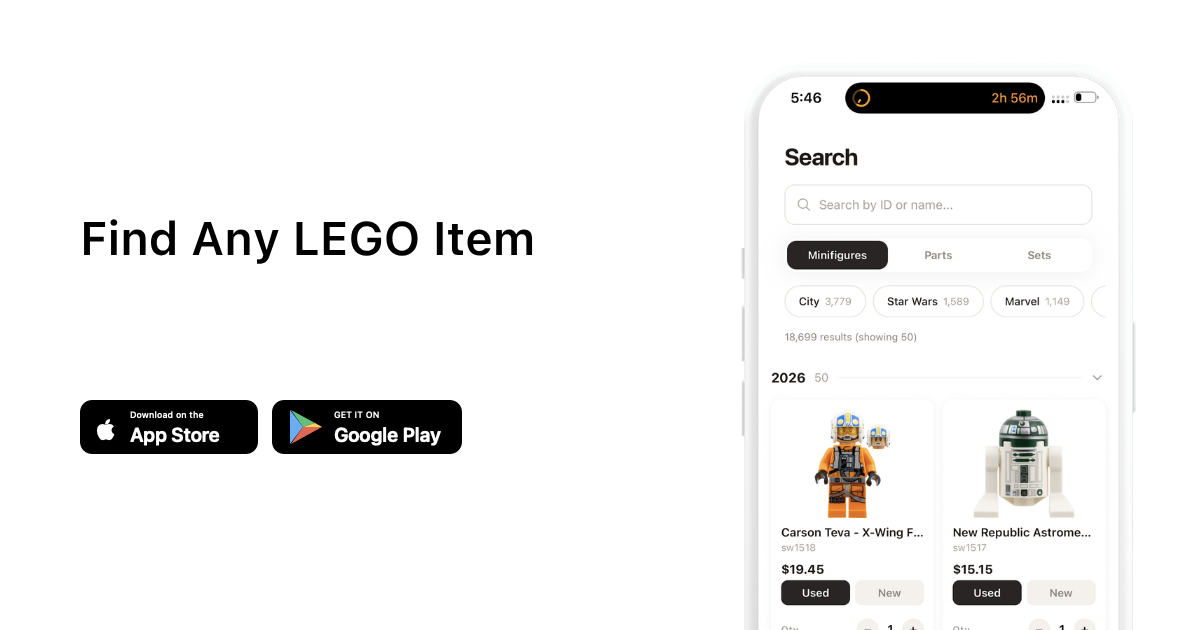


There's a guy on YouTube called MclipsMinifigures who buys entire LEGO collections off people. Like, thousands of minifigures at once. Full rooms of plastic. He pays way less than what it all sells for individually.
Heads up: This is not financial or legal advice. We're sharing what we've learned from the LEGO reselling community. Your situation may be different. Talk to a professional if you need specific guidance.
If you think about what he's actually doing, it's the same thing a private equity firm does when it buys a struggling company. Buy a bunch of stuff at a big discount. Sort through it. Sell the good stuff at full price. Keep the difference.
Except LEGO resellers don't need an MBA or millions of dollars to do it. And honestly? The margins are usually better.
The LEGO secondary market was worth an estimated $705 million in 2024, according to WILCO Toys (we wrote a full breakdown of the market size with platform data and growth trends). That covers online sellers, brick-and-mortar resale stores, LEGO conventions, and live-selling platforms. And it doesn't even count private cash deals, Facebook Marketplace sales, or international markets that are hard to track.
This isn't just a hobby. It's a real industry.
Heads up: This isn't financial or investment advice. The numbers below come from the sources listed at the end of this article. Your results depend on how you source, what you find, and how much effort you put in. Talk to a professional before making financial decisions.
What LEGO Reselling Actually Is: Buying Low, Selling High
Here's how it works. Someone wants to get rid of their LEGO collection. Maybe they're moving. Maybe their kids outgrew it. They throw it on Facebook Marketplace for $200. A reseller picks it up.
Inside that $200 lot? 150 minifigures. Most of them are common, worth $2 to $5 each. But ten of them are worth $20 to $80 on their own. Three might be worth $100+. Add it all up and the total resale value of that lot is somewhere between $800 and $1,500.
That reseller just bought everything at 20 to 50 cents on the dollar.
This isn't some theory. It's what MclipsMinifigures does on camera. It's what Bricks & Minifigs does across 300+ franchise stores. And it's what thousands of regular people do from their houses every single week.
Now think about how private equity works. A PE firm finds an undervalued company, buys it at a discount, fixes it up, and sells it for more. They usually target 20%+ annual returns. The catch? You need millions in capital, years of patience, and a whole team of people.
A LEGO reseller does basically the same thing with $200 and a weekend.
And here's the bigger picture. More and more people are looking at alternative investments. Financiers and collectors are pouring money into Pokemon cards, LEGO, sneakers, and other collectibles as real asset classes. The trading card market alone hit $13 billion in 2025. But there's a gap nobody talks about: somebody has to connect garage sales to asset managers. Someone has to actually find, identify, sort, and price this stuff before it reaches the collectors willing to pay full price. That gap leaves massive room for anyone with $10 to $100,000+ to start making real returns on LEGO. You don't need a fund. You need a phone, a car, and the ability to spot what's valuable.
How It Stacks Up Against Real Estate Flipping
House flipping used to be THE move. Buy cheap, fix it up, sell high. But the numbers have gotten rough.
According to ATTOM Data, the average house flip in Q3 2025 made a 23.1% gross profit. That's down from nearly 30% the year before, and way below the 40 to 60% returns people were making from 2009 to 2020. Flippers right now are seeing their worst margins since the Great Recession.
And that's gross profit. Before you pay for renovations, holding costs, realtor fees, and taxes. After all that, you're usually looking at 10 to 15% net.
LEGO resellers? They're consistently pulling 50 to 90% margins on stuff they source well. A LEGO set you grab at a garage sale for $20 can sell for $80 to $200. One rare minifigure from a bulk lot that cost you basically nothing can go for $50 to $200 by itself.
Here's how they compare:
| Model | Capital needed | Typical margins | Time to return |
|---|---|---|---|
| Real estate flipping | $200K+ | 23% gross (Q3 2025) | 3 to 9 months |
| Dropshipping | $400 to $2,000 | 15 to 20% net | 1 to 4 weeks |
| LEGO reselling | $140 to $500 | 50 to 90% | Days to weeks |
Real estate needs six figures and months of waiting. Dropshipping eats your money on ads and only about 10 to 20% of stores ever make it. LEGO reselling needs a couple hundred bucks, your phone, and knowing what you're looking at.
Why This Beats Most Side Hustles
Most side hustles fall into two buckets. Either you're selling your time (freelancing, tutoring, DoorDash) or you're selling random products (dropshipping, print on demand). The first one caps out at how many hours you can work. The second one is a race to the bottom on margins.
LEGO reselling is something different: you're buying stuff that goes up in value, for less than it's worth.
You're not trading hours for dollars. You're putting money into things that appreciate while you hold them. A study by researchers at HSE University looked at 2,322 LEGO sets from 1987 to 2015 and found they went up in value by 11% per year on average. That beat stocks, bonds, and gold over the same period.
A newer analysis by Brickfact found even higher returns: 15.63% annually from 2011 to 2023.
So even the stuff you don't sell right away is getting more valuable. Compare that to dropshipping inventory, which loses value the second you buy it. Or freelance hours, which disappear the second you stop working.
The Collectibles Boom Makes This Even Bigger
LEGO isn't the only collectible blowing up. This is part of a way bigger shift.
The trading card market passed $13 billion in 2025 and is growing 8%+ per year. Sports memorabilia goes up 10 to 30% annually for the good stuff. Platforms like Rally, Masterworks, and Collectable have raised hundreds of millions so everyday people can buy fractional shares of collectibles.
The basic idea behind all of this: physical stuff with limited supply and growing demand produces returns that compete with (or beat) the stock market. LEGO checks every one of those boxes.
But here's what makes LEGO better than owning a fraction of a Pokemon card or a piece of a painting: you can actually sell it whenever you want. You're not locked into some 5-year fund. Buy a lot on Tuesday, sort it Wednesday, list it Thursday, ship it Friday. The buyers are already there on BrickLink (1 million+ members in 70+ countries), eBay, and Whatnot.
The people making real money aren't treating this like a hobby. They treat it like a portfolio. Every bulk lot is an investment. Every sort session is research. Every listing is a sale.
The Numbers Behind This Industry
Some quick stats to show how real this is:
- $705 million: Total LEGO resale market in 2024 (WILCO Toys)
- $95 million: Bricks & Minifigs franchise revenue in 2025
- 300+ stores: Bricks & Minifigs locations (was just 35 in 2018)
- $300K to $1.2M: What individual Bricks & Minifigs stores make per year
- $8 billion: Total Whatnot live sales in 2025 (LEGO is a top category)
- 1 million+ members: BrickLink buyers across 70+ countries
- $13 billion: LEGO Group revenue in 2025 (up 12%), feeding more supply into the secondary market every year
Every set LEGO makes today will be retired within 1 to 3 years. Once it's gone, the only supply left is what's already out there. Demand stays the same or grows. That's what keeps pushing this market up year after year.
The MclipsMinifigures Model: Buying Collections at Scale
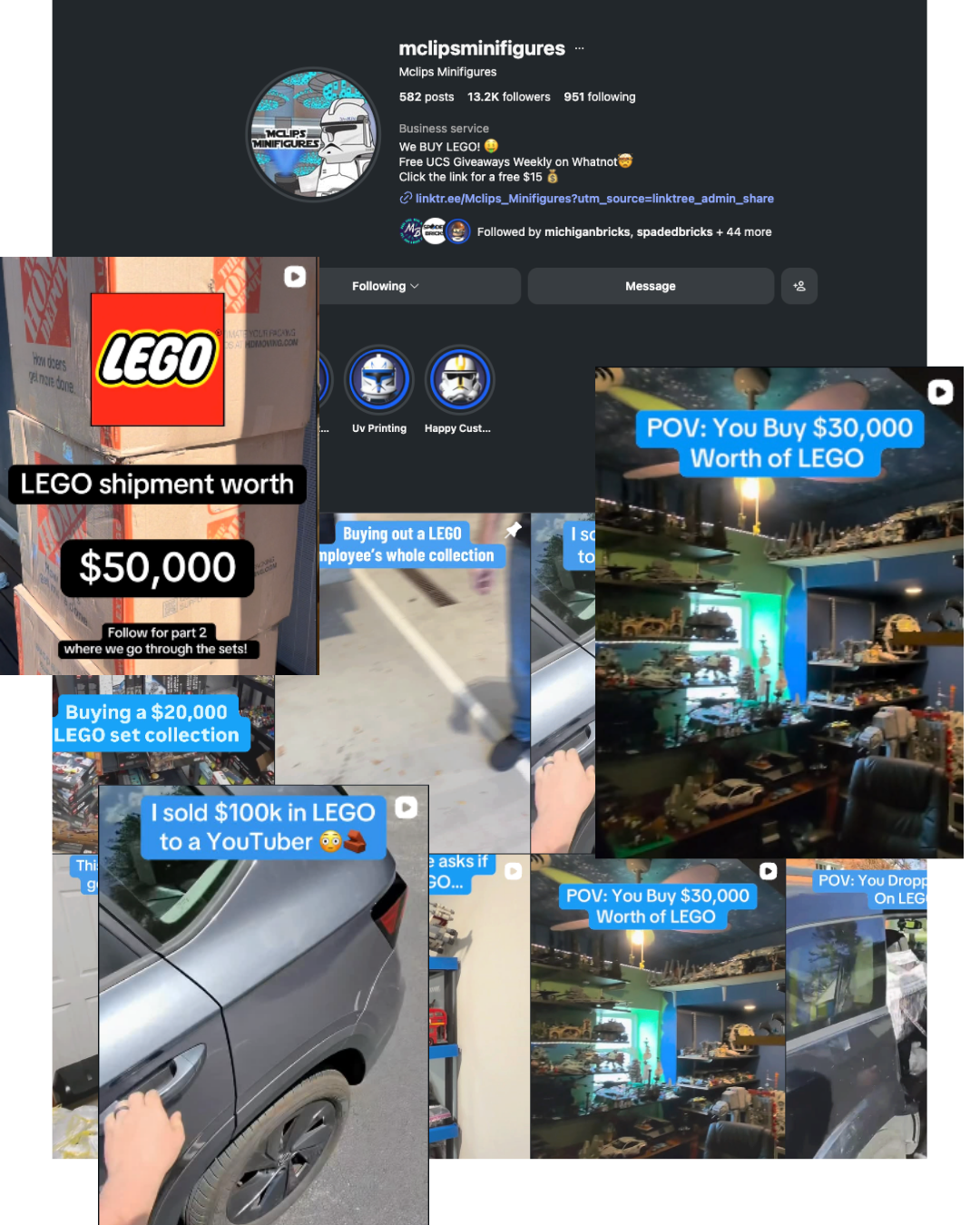
Watch a few MclipsMinifigures videos and you'll spot the pattern fast. He buys whole collections. Not a figure here and there. Hundreds or thousands at once. Sometimes he drives to someone's house with cash. Sometimes it comes through the mail.
It's the same playbook private equity uses when they buy entire companies. You're not picking individual stocks. You're scooping up a whole portfolio in one shot, at a price that reflects the seller wanting it gone fast, not the actual value of each piece.
The seller gets quick cash without the hassle of listing 500 items one by one. The buyer gets instant profit because they paid way under what it's all worth individually. Both sides are happy. But the reseller keeps the difference.
That's why LEGO reselling is more like running an investment operation than running a store. You're not making anything. You're not creating demand. The demand already exists. You're just moving stuff from people who don't know what they have to people who'll pay full price for it.
Why Most People Sleep on This
The reason nobody takes LEGO reselling seriously at first is because it sounds like "selling toys." People hear that and imagine a folding table at a yard sale.
They don't picture a $95 million franchise chain. They don't think about university studies showing 11% annual returns. They don't imagine sellers moving hundreds of figures a week with real inventory systems and shipping setups.
But the people actually doing it? They're quietly building real income. Some as a side thing while they work a regular job. Some as their whole business. What they all have in common is they ran the numbers and realized it works.
Buy at 20 to 50% of value. Sell at 100%. The stuff goes up in price while you hold it. The buyers are everywhere. You can start with less than $500.
Find another asset class where all of that is true. Seriously.
Frequently Asked Questions
How big is the LEGO resale market?
The independent LEGO resale market was estimated at $705 million in 2024 by WILCO Toys. That covers online sales, physical stores, conventions, and live platforms. The real number is probably higher since it doesn't count private sales and cash deals.
Is LEGO reselling more profitable than real estate flipping?
In terms of percentages, yeah. LEGO resellers pull 50 to 90% margins on well-sourced stuff. House flippers averaged 23.1% gross margins in Q3 2025 (ATTOM Data), their lowest since 2008. LEGO also needs way less money to start.
Do LEGO sets actually go up in value?
Research from HSE University found LEGO sets appreciate 11% per year on average from 1987 to 2015, beating gold and stocks. Brickfact found even higher returns of 15.63% annually from 2011 to 2023. Not every set goes up equally though.
How much do you need to start?
As little as $140 to $500. One bulk lot from Facebook Marketplace or a garage sale is enough. The real skill is knowing what you're looking at. If you can identify the valuable stuff fast, you make money. If you can't, you don't.
Can you resell LEGO as a side hustle?
Absolutely. Most people start part-time. Low startup cost, flexible schedule, and you can sell stuff the same week you buy it. A lot of full-time resellers started doing 5 to 10 hours a week while keeping their day job.
What LEGO is most profitable to resell?
Rare minifigures have the highest margins by far. A figure that costs you basically nothing inside a bulk lot can sell for $20 to $200+. After that, retired licensed sets (Star Wars, Harry Potter) and rare individual parts like chrome gold pieces do really well.
What tools do LEGO resellers use?
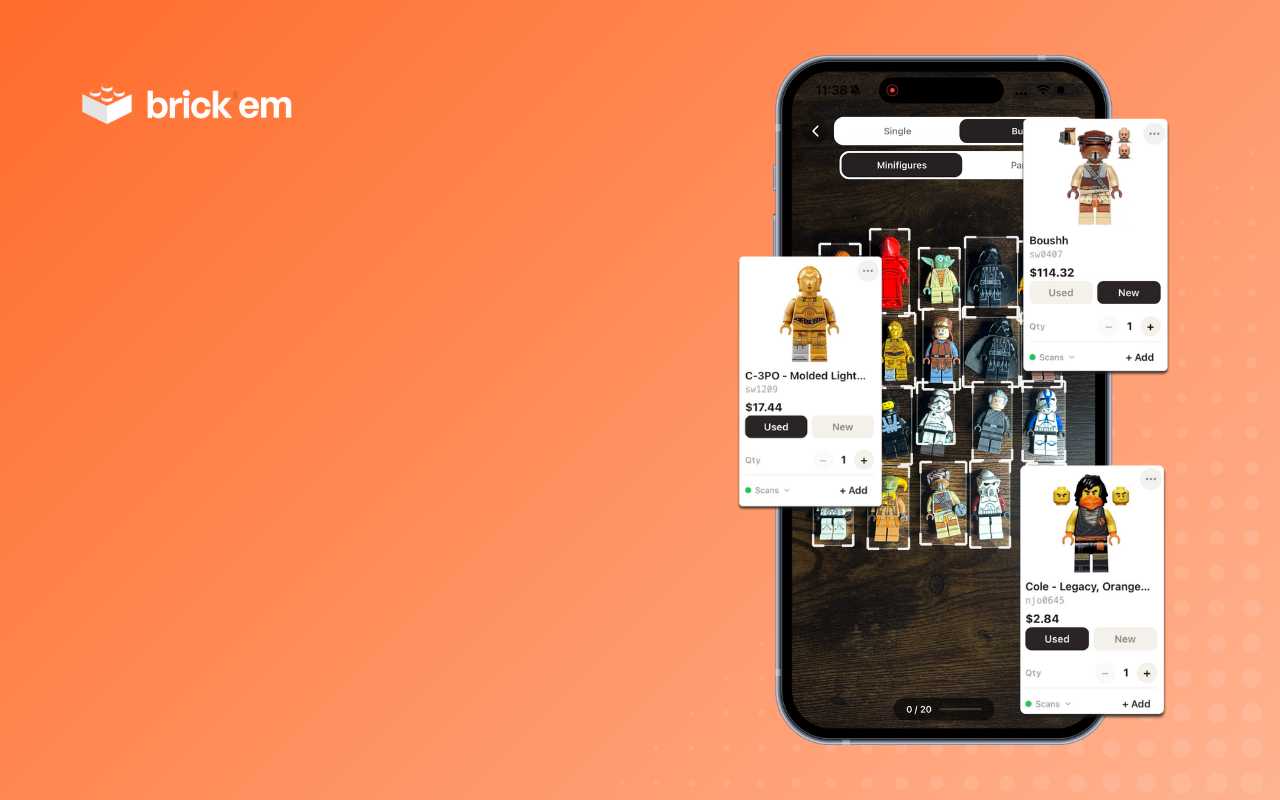
brick'em lets you scan a whole pile of minifigures in one photo and instantly see what everything is worth with live BrickLink prices. It replaces hours of looking stuff up one by one. Most serious sellers use scanning tools, inventory trackers, and list across multiple platforms.
Related reading
- LEGO Reselling for Beginners: 2026 Startup Guide
- New vs Used LEGO Minifigure Prices
- LEGO Profit Margin Calculator Tips
Ready to try it? brick'em turns a pile of unknown figures into a priced, organized inventory in minutes. Snap a photo, see what it's all worth, export to any platform. Start your free trial.
Sources
- WILCO Toys. "Market research and sales data for the LEGO economy." wilcotoys.com/economics-of-lego (2024 market estimate: $705M)
- Dobrynskaya, V. & Kishilova, J. "LEGO: The Toy of Smart Investors." Research in International Business and Finance, 2021. (11% annual returns, 1987-2015)
- Brickfact. "Better returns with LEGO than with gold and shares." brickfact.com (15.63% annual returns, 2011-2023)
- ATTOM Data Solutions. "Q3 2025 Home Flipping Report." attomdata.com (23.1% gross margins, lowest since 2008)
- Bricks & Minifigs. "Surpasses 300th Store, Doubling Growth in Just 2 Years." bricksandminifigs.com, January 2026. ($95M systemwide revenue, 300+ locations)
- Whatnot / Sacra. Revenue and valuation data. sacra.com/c/whatnot ($8B+ total live sales 2025)
- Upright Labs. "Why LEGO Dominates the Online Resale Market." uprightlabs.com, March 2025. (Resale margin data, platform comparisons)
- CNBC. "Lego 2025 earnings: How the company keeps beating the toy industry." March 2026. ($13B revenue, 12% growth)
- HSE University. "Toys Prove to Be Better Investment Than Gold, Art, and Financial Securities." hse.ru/en/news (Original research announcement)
- MclipsMinifigures. YouTube channel and eBay store. youtube.com/c/MclipsMinifigures
Note: These are estimates based on the sources above. The LEGO resale market doesn't have one official data source, and actual results depend on what you source, when you sell, and how much work you put in. Past performance doesn't guarantee future results.