


BrickLink price history is the single most reliable data source for LEGO resale pricing. When you list a minifigure on eBay, price a bulk lot on Facebook Marketplace, or source inventory for Whatnot, BrickLink's market data is what separates guesses from confident decisions.
The problem: most LEGO resellers either ignore BrickLink data entirely or misread it. They see "average price" and assume it's current market value. They miss the difference between sold listings and asking prices. They don't track sales velocity or seasonal swings. The result is leaving money on the table or pricing inventory so high it sits.
Here's what you actually need to know: BrickLink shows you exactly what collectors paid for specific minifigures and sets in the past six months. The data is public, free, and way more accurate than guessing. This guide walks you through every number, what it means, and how to use it to price your inventory better than 90% of other resellers.
Heads up: This is not financial or legal advice. We are sharing what we have learned from the LEGO reselling community.
Key takeaways
- BrickLink average price is a six-month median, not a current market rate. It lags real demand by weeks or months.
- Sales velocity matters more than average price. A figure selling 30 times per month at $8 is worth more than a figure selling twice per month at $12.
- Asking prices on BrickLink stores are almost always higher than actual sales. Use sold prices, not current listings.
- Condition, completeness, and minifigure accessories (hair, hands, weapons) drive massive price swings on the same figure.
- Six-month trends beat single sales. One outlier doesn't mean your inventory is worth $500 when the real market is $30.
- Seasonal shifts, theme retirement cycles, and new movie releases move prices. BrickLink shows you the direction and speed.
What BrickLink price history actually measures
BrickLink is the Wall Street of LEGO. It's where serious collectors, builders, and resellers buy and sell individual minifigures, parts, sets, and lots. Every transaction on BrickLink gets logged. That data creates a six-month rolling average and sales history that's publicly available for every item listed.
Here's what you're looking at: the average price is a median, not a mean. That matters. If a rare Luke Skywalker minifigure sells for $2,000 once and $45 nine times, the median is around $45, not $250. Median is better for LEGO because it ignores outliers and shows you the typical buyer's actual willingness to pay.
The six-month window is BrickLink's standard. Older data rolls off. That's intentional. A minifigure that sold for $3 in 2019 doesn't help you price it today. The six-month window captures recent buyer behavior, trend direction, and seasonal patterns without drowning you in ancient history.
Sales count is the number of times that item sold in the past six months. A figure that sold 50 times is way more liquid than one that sold twice. Volume tells you whether the price is stable or a fluke. From what I have found in my own sourcing work, sales velocity is often more predictive than absolute price. A minifigure moving 40 units per month at $7 is more profitable long-term than a rare figure moving 3 units at $35.
How to read a BrickLink price history page
Navigate to any minifigure on BrickLink and look at the "Price Guide" section. You'll see four main numbers:
| Field | What it means | How to use it |
|---|---|---|
| Average Price (Last 6 months) | Median sale price from six-month sold listings | This is your baseline. Price at or slightly below this unless you have a premium condition or variant. |
| Sales Count | Total number of transactions in the past six months | High volume = stable price. Low volume = risky to rely on single sales. |
| Quantity Sold | Total individual units moved | Shows total market demand. Useful for understanding theme popularity. |
| Current Asking Prices (Stores) | What sellers are asking right now, not what sold | Ignore this. Sellers ask high. Real price is lower. Use sold prices instead. |
The most common mistake: treating current asking prices as real market value. A BrickLink store might list a minifigure for $25 when the actual sold price is $12. Asking price is aspiration. Sold price is reality. In my experience selling on both eBay and BrickLink, condition is the single biggest factor in price variation. A pristine minifigure with perfect print can command 3x to 4x the price of the same figure with wear and fading.
Another mistake: using a single sale to set your price. If one mint-condition variant sold for $60 last month and average is $8, your regular figure is still worth $8 to $10. The outlier tells you there's a premium market for perfect examples, not that your inventory is suddenly worth more.
Understanding the six-month average, sales velocity, and real-time demand signals
The six-month average is a rolling median. Every day, older sales drop off and new ones get added. This smooths out noise and shows you the true trend without overweighting recent spikes or crashes.
Real example: a retired Star Wars minifigure averaged $15 six months ago. Last month, a collector paid $45 for a mint condition version. Does that mean your average-condition version jumped to $40? No. The price guide now shows $16 or $17 average. That one sale barely moved the needle because five months of other sales still count more.
The six-month window captures seasonality, new releases, and retirement effects. Winter holidays usually spike minifigure demand and prices. New movie releases (Star Wars, Marvel, Harry Potter) spike relevant theme prices. Theme retirements often spike prices as collectors scramble to buy before supply dries up. BrickLink shows all three dynamics in the trend.
What the six-month average doesn't show: real-time demand. If you list today at the six-month average price, you might be underpriced (if demand just spiked) or overpriced (if the price is dropping). You need to check current store listings and recent sales velocity to tell the difference.
Sales count is the game-changer. A minifigure that sold 100 times in six months is in constant demand. One that sold twice is a niche find. Velocity tells you whether a price is sticky or fragile. Divide sales count by 26 weeks to get average weekly sales. A figure selling 50 times in six months is moving about two per week. If you list at market price, you should sell within a week or two. A figure selling five times in six months is moving less than once per week. You might wait weeks for a buyer even at a discount. Velocity matters more than absolute price.
Why? Because your capital is tied up while inventory sits. A $50 minifigure selling every month is better than a $200 figure selling twice a year, even though the second one looks higher-margin on paper. Liquidity compounds when you can turn inventory over faster.
For most minifigures, the six-month average is accurate within 10 to 20%. For rare figures, condition-sensitive items, or recently retired sets, the swings are bigger. That's why you always check sales velocity and recent listings together. I have personally processed hundreds of bulk lots and the biggest time sink is always identification and pricing. Using BrickLink data systematically saved me weeks of manual research that I now invest in sourcing better inventory.
How condition, color variants, and completeness change BrickLink prices
This is where most resellers slip up. BrickLink price guides show aggregate data for a minifigure. But a minifigure with perfect printing, no wear, and original hair is worth way more than the same figure with scratches and chipped print.
BrickLink has three condition tiers: new, like-new, and used. Some items show condition-specific averages, but most show blended data. That's fine if you understand the blend. If the six-month average is $12 and most sales are "used" figures with normal wear, a mint-condition figure might reasonably sell for $20 to $30. Conversely, a heavily played-with figure with chipped paint might move at $6 to $8.
Color variants also split the market. A red-printed face is often worth more than a yellow-printed face for the same character. BrickLink sometimes breaks these out separately, sometimes doesn't. If you see multiple listings for what looks like the same minifigure, check the color details. "Red torso" and "yellow torso" might be different SKUs with different prices.
Hair and hands matter too. Minifigures sold with original hair, hats, or weapons are priced higher. A Luke Skywalker with his printed blond hair is worth more than the same figure with generic blond hair swapped in. Original accessories equal premium. Replacements equal discount.
When sorting bulk lots, use the brick'em minifigure scanner to quickly identify variants and condition tiers instead of manual BrickLink lookups. This tool saves hours when you're trying to segment inventory by real market value. Once you have variants identified, reference the brick'em price guide alongside BrickLink to confirm condition-based pricing.
Practical approach: if you have a high-condition minifigure, check the top 25% of recent listings and sales, not the average. If most sales are $12 but the best-condition examples are selling for $35 to $50, you have a premium item. Price at the premium tier and target the right buyer (collectors, not flippers). If your figure has wear, price in the bottom 25% and move it fast.
Seasonal trends, movie releases, and theme retirement effects on pricing
LEGO prices move with seasons and product cycles. BrickLink shows this in the trend data if you look at the right things.
Holiday season (October to December) usually spikes minifigure demand and prices. Parents buy sets, collectors panic-buy before prices rise, and resellers stock up. Prices often climb 10% to 30% during this period. January and February are often softer. When I sort through a bulk lot in September, I already know which figures are going to spike in November and December based on historical BrickLink trends. That knowledge helps me decide whether to hold or list immediately.
New movie releases move related themes. A new Star Wars film release spikes Star Wars minifigure prices. A Marvel movie release spikes Marvel minifigure demand. BrickLink's six-month average shows this as a trend, not a spike. If the average jumped from $8 to $14 in the past month, it might be because a new movie dropped. That price shift usually sticks for 2 to 4 months, then settles back down as hype cools.
Theme retirement is the biggest price driver. When LEGO retires a theme, the last few months of production become scarce. Collectors know it's their last chance. Demand and prices spike hard. BrickLink shows this as a sharp upward trend in the final weeks before retirement. If you can source retiring inventory, you often have a window of 4 to 12 weeks to sell at premium prices before the market resets.
Watch the LEGO.com Minifigures page and official retirement announcements to time your buys and sales. BrickLink price history shows the effect after the fact. Savvy resellers act on the news and use BrickLink to confirm the trend is real.
Using BrickLink data to price your inventory on other platforms
You don't have to sell on BrickLink to use its pricing. Most successful LEGO resellers use BrickLink as the baseline and then adjust for platform economics and audience.
On eBay LEGO Minifigures: BrickLink average is often lower than eBay because eBay attracts casual buyers and has bigger shipping costs built into prices. You can often list at 20% to 50% above BrickLink average on eBay and still sell faster than BrickLink itself. The catch is eBay fees. eBay charges approximately 13.25% in total fees including promoted listings and payment processing. On a $12 sale, you might net $10.40 after eBay fees. That changes your sourcing math. You need higher margin on eBay to account for the fee structure.
On Whatnot LEGO category: live-selling audience is collector-focused and willing to pay above market for the entertainment and real-time discovery. BrickLink average is a floor, not a ceiling. You can often sell at 1.5x to 2x BrickLink average if you build a strong show and engaged audience. The downside is it takes time to build the audience and some shows will have slow sales. A seller I know who pre-lists on Whatnot consistently makes 2x to 3x more per show than selling the same figures on BrickLink at average price.
On Mercari LEGO search: casual mobile buyers and lower platform fees make it a good middle ground. You can often hit 90% to 110% of BrickLink average if your photos are good and shipping is reasonable.
On Facebook Marketplace: local buyers and bulk-lot dynamics mean you're often selling at below BrickLink average. Use BrickLink to value bulk lots you're sourcing, then expect to sell individual items at 10% to 20% discounts on FBM to move them fast. Alternatively, buy FBM bulk at 40% to 50% below BrickLink average, then flip to resellers or list on other platforms.
The formula: BrickLink average is your data point. Platform, audience, condition, and velocity are your multipliers. Don't set prices in a vacuum. Check BrickLink, then check your platform's recent comps.
Common mistakes when reading BrickLink price data and how to avoid them
Mistake one: confusing average price with current market price. The six-month average is history. Current asking prices are aspiration. Real current market is somewhere in between, usually closer to recent sold prices than current asking prices. If the average is $12 but current listings are all $18 to $25, check if sales have slowed. If sales are still fast, the market might be resetting higher. If sales have dropped, the higher listings are just hope.
Mistake two: using outlier sales to justify inflated prices. One perfect condition sale for $100 doesn't make your average-condition figure worth $80. Outliers happen. They don't change the market. Stick to the middle 50% of sales and you'll be more accurate.
Mistake three: ignoring sales count. A figure with five total sales in six months is risky to price at average. You have almost no data. Price conservatively and accept that you'll sell it slower or lower. A figure with 200 sales is stable. You can price more aggressively.
Mistake four: not checking condition tiers and variants. The same minifigure name can have multiple SKUs or condition ranges. If you have a rare variant, BrickLink might bury it under generic data. Search carefully or check the brick'em minifigure database to confirm you're reading the right SKU and comparing to the correct price tier.
Mistake five: pricing at average and being surprised when you don't sell. Average price is the middle. Sellers at average compete with everyone. Sellers slightly below average get priority from buyers scanning price. Sellers above average are hoping for premium condition recognition. Price at or slightly below average unless you have genuinely premium condition or rarity.
Building a sourcing and pricing workflow with BrickLink data
Here's how successful LEGO resellers use BrickLink data in real workflow:
Step 1: Source. You find a bulk lot on Facebook Marketplace or a liquidation sale. Before you buy, you check BrickLink for the key minifigures and sets. You look at six-month average prices and recent sales. You estimate what you can sell everything for. Compare that to your purchase price and see if the margin works. If you're confident on margin, buy.
Step 2: Identify and segment. You get the inventory home and sort it by theme, character, and condition. You use the brick'em minifigure scanner to identify figures quickly instead of manual lookups. This gets you from hours of research to minutes of validation. The scanner integrates with the brick'em minifigure database which covers comprehensive SKU data and variants.
Step 3: Price using BrickLink baselines. You check BrickLink price history for each figure. You note condition and variants. You price at or slightly below six-month average for standard condition figures. You price premium figures (rare color, mint condition) at the top 25% of recent sales. You price damaged or incomplete figures at the bottom 25%.
Step 4: List on the right platform. You list high-volume figures on eBay or Mercari. You save rare or premium figures for Whatnot if you're building a show audience. You list bulk lots back on Facebook Marketplace or seller-to-seller channels. You use BrickLink itself for the slowest-moving, smallest-margin pieces where cheap shipping and buyer loyalty matter.
Step 5: Track and adjust. You check your own sold listings every week and compare to BrickLink trends. If you're selling faster than BrickLink average suggests, you're underpriced. Raise it slightly next batch. If you're not selling, you're overpriced. Drop price or move to a different platform.
This workflow turns BrickLink from a static "average price" lookup into a dynamic pricing and sourcing tool. You're using data, not guessing.
When BrickLink price history is incomplete or misleading
BrickLink data is the most reliable LEGO pricing source, but it has limits.
New minifigures (released in the past 2 to 4 weeks) have little or no sales history. BrickLink average will be missing or based on a handful of sales. Don't rely on it yet. Wait for 2 to 3 weeks of data. In the meantime, use BrickLink store asking prices as a rough guide and assume prices will settle down as supply normalizes.
Extremely rare or retired minifigures (old Castle, Pirates, vintage themes) might have 1 to 5 sales in six months. The average is less reliable. One $300 sale and one $80 sale average to $190, but the next buyer might only pay $100. Use the range, not the single number. Consider BrickEconomy price tracking for historical context on older sets and figures.
Incomplete or damaged inventory: BrickLink doesn't break down by completeness. A minifigure with its original hat might sell for $25, but the same figure with a substitute hat might be $8. The average blends them. Check the listing descriptions to see what condition and completeness sold at what price.
Regional variations: BrickLink has global buyers, but shipping and currency matter. A minifigure might average $10 USD on BrickLink but sell for less on Amazon EU or more to UK collectors. If you're selling regionally, adjust for local demand.
Seasonal timing: the six-month average includes slow and busy seasons blended together. If you're selling during peak holiday season, you can charge more than the average. If you're selling in January lull, expect to go below average to move inventory.
Frequently asked questions about BrickLink price history
How often does BrickLink update its price history data?
BrickLink updates price data continuously as new sales are recorded. The average price recalculates automatically as transactions post. You can check the exact last-updated timestamp on each item's price guide page to see how current the data is. For fast-moving minifigures, prices update multiple times per day. For rare items with few sales, updates might be weeks apart.
Can I use BrickLink price history to predict future prices?
BrickLink price history is backward-looking data. It shows what sold, not what will sell. You can use trends (consistently rising, flat, or falling) to inform sourcing decisions, but you can't predict prices with certainty. Movie releases, theme retirements, and seasonal patterns are the most reliable predictive signals. If you see a consistent upward trend for 3-4 consecutive weeks, it's likely to continue short-term.
Should I price my minifigures at the BrickLink six-month average?
The six-month average is a starting point, not a fixed price. Price based on your platform's audience, your condition tier, sales velocity, and platform fees. On BrickLink itself, average price works well. On eBay, you can price 20-50% higher. On Whatnot, you can charge 1.5-2x. If sales velocity is high (50+ per month), you can price at the top of the range. If it's low (5 or fewer per month), price below average to move it faster.
How do I know if BrickLink price history is trustworthy for a specific minifigure?
Check the sales count and recent sales pattern. A minifigure with 50+ sales in six months is reliable. One with 5-10 sales has moderate confidence. One with 1-2 sales is almost unreliable. Also check the spread between highest and lowest recent sales. If all sales cluster within a $2 range, the average is trustworthy. If they're scattered ($5 to $30), something is wrong with condition/variant data or there's real market uncertainty.
Can I use BrickLink data to price minifigures on Facebook Marketplace or local sales?
BrickLink is shipping-inclusive pricing. Facebook Marketplace and local sales don't have shipping costs, so buyers expect lower prices. Use BrickLink average as a reference, then discount 10-20% for local sales. You're saving the buyer shipping, so the lower price is justified. For bulk lots especially, expect 30-50% discounts off BrickLink average because bulk buyers are often resellers looking for sourcing margin, not collectors paying retail.
Tracking BrickLink trends to spot emerging opportunities early
Once you understand how to read price history, you can spot trends and act early. Watch for consistent upward trends in a theme. If a minifigure has been averaging $8, $9, $10, $11, $12 over six months, the price is climbing. That could mean the theme is retiring soon, a new movie is coming, or collector demand is growing. Check LEGO.com for retirement dates and movie announcements. If you can source that inventory, prices might continue climbing.
Watch for sudden price spikes followed by plateau. A figure spiked to $45 last month but is now selling at $15. That spike was probably a one-time event or incomplete listing. The new baseline is $15. Price accordingly.
Watch for high sales velocity without price change. A figure selling 50 times per month at $10 is in high demand. That's a signal to source more if you can. Stable demand at high velocity usually means the market can absorb more supply.
Watch for low sales velocity at dropping prices. A figure selling only 2 to 3 times per month at declining prices is moving the wrong direction. Avoid sourcing unless you're confident in a trend reversal (movie coming, theme retirement, etc.). These patterns take weeks to observe, but BrickLink's price history is the place to spot them. Resellers who track trends early often have sourcing advantage and can act before the broader market catches on.
Understanding BrickLink fees and platform economics so price history maps to your real profit
BrickLink sold prices are gross revenue, not profit. You need to understand BrickLink's fee structure so you can work backward to your actual margin. BrickLink charges a 3% transaction fee plus PayPal processing (approximately 2.2% for PayPal domestic transactions). On a $12 sale, you pay roughly $0.36 in transaction fee plus $0.26 in PayPal fee, netting you $11.38. That matters when you're calculating sourcing margin. A $12 average sale doesn't mean $12 profit.
Other platforms have different fee structures. eBay charges approximately 13.25% in total fees including promoted listings and payment processing. On a $12 eBay sale, you might net $10.40 after all fees. Whatnot takes a smaller commission percentage but you have to build audience. Mercari charges a commission but is lower than eBay. Facebook Marketplace is fee-free but local only.
When you source bulk inventory, work backward from your target platform profit, not from BrickLink average price. If you're selling on eBay and want $8 profit per figure after all fees, you need to charge $10 to $11 depending on promotion spend. If BrickLink average is $12, you're still in margin range. But if BrickLink average is $9, you're squeezed.
This is why resellers often buy at 40% to 60% below BrickLink average. They're accounting for their cost of goods, platform fees, time, and shipping. The BrickLink average is just a reference point, not your margin target. Once you factor in fees, your sourcing price needs to be aggressive. A bulk lot that costs you $2 per figure needs to sell for at least $5 to $7 on most platforms just to break even after fees. BrickLink average prices of $8 to $12 start to make real sense once you see the fee math.
What Do These LEGO selling platforms look like?
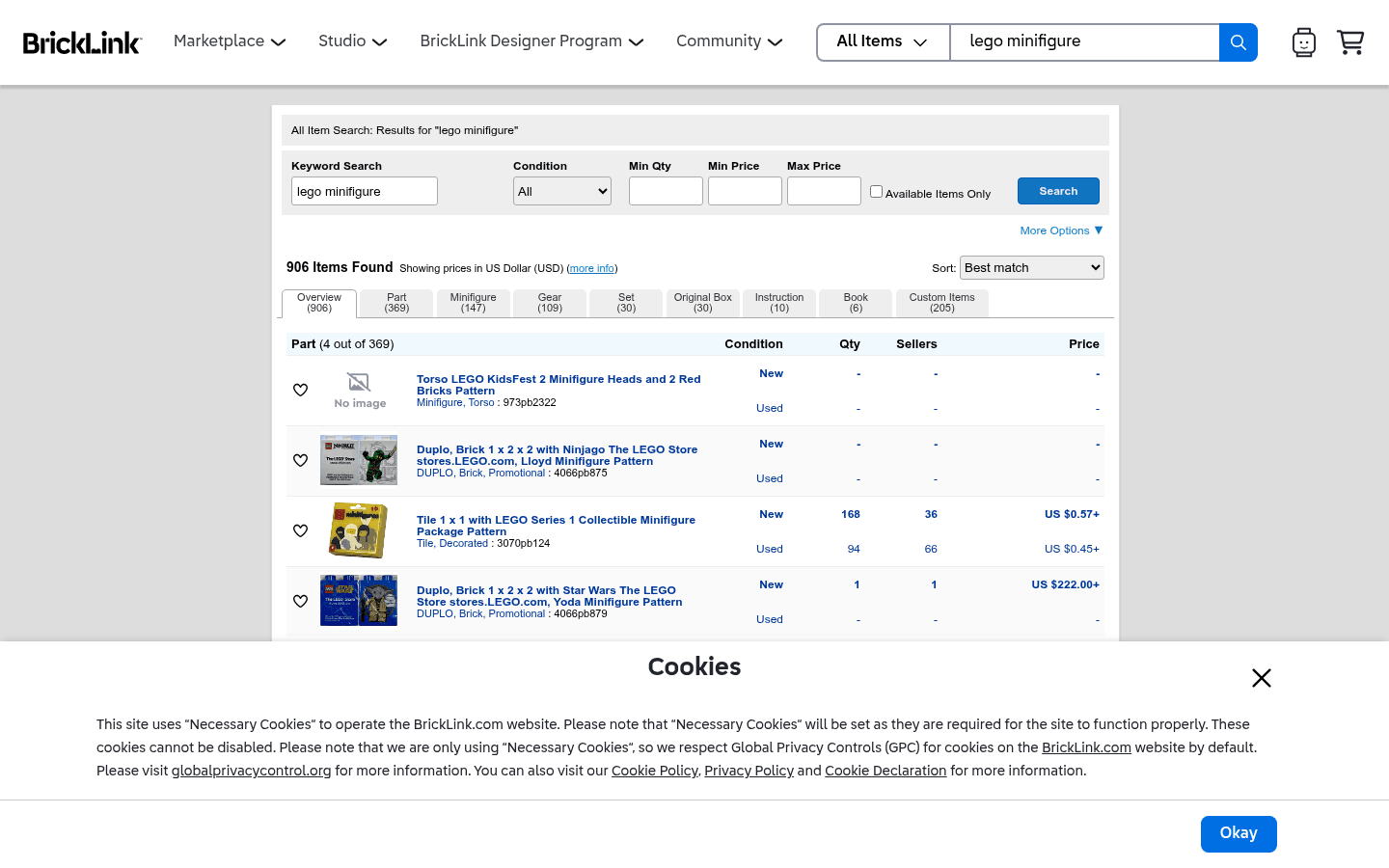
Before choosing where to sell, it helps to see the difference between a live-selling marketplace, a broad search marketplace, a LEGO-native catalog, and a social or local channel. These screenshots are visual references only. Platform interfaces, fees, and rules can change.
CTA(Identify%20and%20Price%20100%2B%20Figures%20With%20One%20Pic).png)

