

Somewhere around your third bulk lot, it clicks. You stop seeing a pile of random LEGO figures and start seeing money sitting on a table. That Star Wars helmet is not just a cool piece. It is $35 on BrickLink in used condition. The plain City cop next to it? Two bucks. But that tiny Harry Potter variant hiding behind them both? Sixty dollars. And you almost tossed it in the commons bin.
That moment is what hooks people on LEGO reselling. The margins are real. A $50 bulk lot from Facebook Marketplace can hold $200 to $400 in individual figure value. Sometimes more. The secondary market for LEGO minifigures is one of the most active collector markets in the world, and most people walking past bins at garage sales have no idea.
But knowing the opportunity exists and actually capturing it are two very different things. The difference comes down to one boring, unsexy thing: how fast you can process a lot.
What Slows Every Reseller Down
There are over 18,900 LEGO minifigures. Tens of thousands of individual parts. Each one has a specific BrickLink ID, a name that sometimes makes sense and sometimes does not, condition grading that affects price, and market values that shift week to week. When you dump 150 loose figures out of a Ziploc bag, that is the complexity you are looking at.
The old way of handling it: pick up a figure, open BrickLink, try to describe what you see, scroll through dozens of similar-looking results, find the right match, check the price guide, write it down somewhere, move on to the next one. Two to three minutes per figure if you know what you are doing. Longer if you do not.
At that speed, a 100-figure lot is a full afternoon. A 300-figure lot is a weekend project. And you have not even started photographing, listing, or shipping anything yet. The identification and pricing step alone eats more time than every other part of the process combined.
This is where most people tap out. Not because the money is not there. Because the grind between buying and selling feels endless when you are doing it manually. You bought the lot to make money, not to spend your Saturday squinting at torso prints on a laptop screen.
The Collectors vs Sellers Split
Here is something that took me a while to figure out. Most LEGO tools and apps were built for collectors. And collecting and selling are fundamentally different activities with different needs.
A collector wants to identify a cool figure they found at a flea market. They scan it, get a name, maybe look up some history. Done. That experience is satisfying and complete. The figure goes on a shelf. There is no urgency, no volume, no next step.
A seller has a completely different relationship with that figure. They need to know what it is, what it is worth in the current market, where it fits in their inventory, and how to get it listed on a platform where someone will buy it. Identification is step one of four. And step one is the only step most apps handle.
That disconnect explains why so many resellers end up cobbling together a Frankenstein workflow. One app to scan. BrickLink in another tab to check prices. A spreadsheet to track inventory. Manual data entry to create listings on whatever platform they sell on. Four separate tools, none of them talking to each other, and the human in the middle doing all the copying and pasting.
It works. Barely. But it does not scale. And scaling is the whole point if you want this to be more than pocket money.
What Actually Matters in a Scanning App
After processing enough lots, you learn what matters fast. It is not the flashiest interface or the coolest AI. It is the stuff that shaves minutes off every single figure you touch.
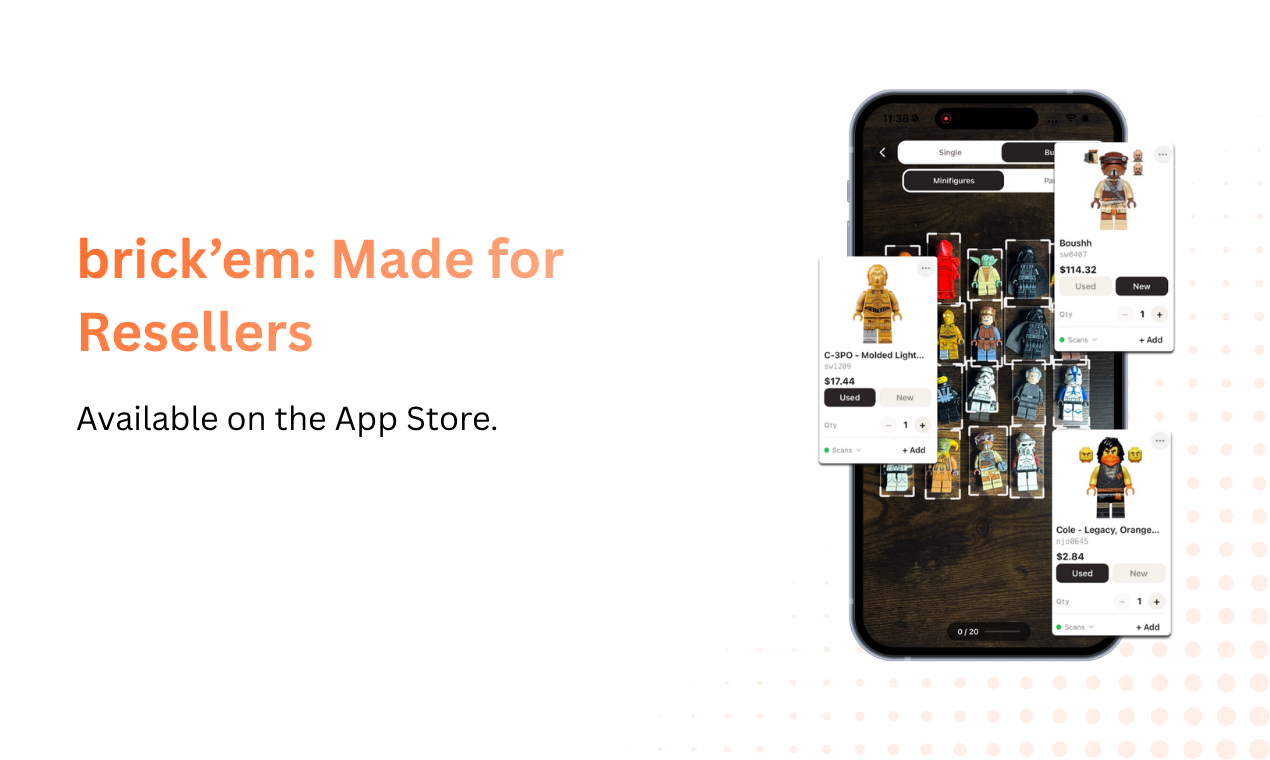
Scanning more than one figure at a time. This is the single biggest time multiplier. Lay out 15 or 20 figures, take one photo, get results for all of them. Compare that to picking up each figure individually, centering it, snapping a photo, waiting for results, and repeating 200 times. The difference is hours.
Prices showing up automatically. If you scan a figure and then still have to open BrickLink to check the value, the scan barely saved you anything. The price needs to be right there on the result. Used and new. No extra steps.
Somewhere for the data to live. Scan results that disappear when you close the app are useless for inventory management. You need persistent storage. You need to know what you have, what the total is worth, and what you have already sold. That is how you track margins and know whether your sourcing strategy is working.
Getting the data out. Eventually those figures need to become listings on BrickLink, eBay, Whatnot, Shopify, or wherever you sell. If you are retyping every name, ID, condition, and price into a listing form, you are spending more time on data entry than you saved on scanning.
Quick math: At 2 to 3 minutes per figure manually, a 100-piece lot takes 4 to 5 hours. Bulk scanning that same lot takes under 30 minutes. The time you save on a single lot is worth more than most app subscriptions cost in a year.
Where the Money Actually Is
People get into LEGO reselling for different reasons. Some want a side hustle. Some want a full business. But the math works at every level if you understand where the value sits.
Bulk lots on Facebook Marketplace, estate sales, and garage sales typically price at $3 to $8 per pound. Sellers are usually parents clearing out a kid's old collection. They do not know or care about individual figure values. They want the bin gone.
Inside those bins, the total BrickLink value of the minifigures alone is often 3x to 10x the purchase price. Star Wars, Harry Potter, and Marvel figures carry the highest individual values. But even common City and Ninjago figures add up fast when you are moving volume.
The sellers who do well are not the ones who find the single $200 grail figure. Those are exciting but rare. The real money is in consistent volume. Processing 5 to 10 lots per month, pulling out the valuable figures, bundling the commons into themed lots, and listing everything across multiple platforms.
That kind of volume is only possible when your processing time per lot is short. If every lot takes a full day of manual work, you max out at maybe 2 per week. If you can process a lot in an hour or two, you can handle 2 to 3 per day during a good sourcing week.
The Tool That Finally Got It Right
I spent a long time using the patchwork method. Scanner app, BrickLink tab, spreadsheet, manual listings. It worked until it did not. Around the time I started doing 8 to 10 lots a month, the manual steps became the actual bottleneck. Not sourcing. Not shipping. Just the tedious middle part.
brick'em is the first tool I found that actually handles the full workflow. Not just identification. The full thing. You lay out your figures, scan a batch in one photo, and every figure comes back identified with BrickLink market prices. From there you add them to your inventory, track total value, and export formatted listing files to Whatnot, eBay, BrickLink, or Shopify. The database covers 18,900+ minifigures and 93,000+ parts.
The Chrome extension is a nice bonus for sourcing. You are browsing a lot on eBay or Facebook Marketplace, you right-click a photo in the listing, and it tells you what figures are in it and what they are worth. Helpful for deciding whether a lot is worth the drive before you commit.
There is a 14-day free trial with everything unlocked. After that it is $20 a month or $200 for the year. I do not love paying for subscriptions any more than anyone else, but the math on this one is not close. The time it saves on a single lot covers the cost for months. And they have a 20-hour guarantee. If you do not save at least 20 hours in your first month, full refund, no questions.

Frequently Asked Questions
Is LEGO reselling actually profitable?
Yes. Bulk lots typically cost $3 to $8 per pound, and the individual figure value inside is often 3x to 10x the purchase price. The profit depends on your sourcing and how efficiently you process and list. Sellers doing 5 to 10 lots per month regularly clear consistent side income.
What is the fastest way to identify LEGO minifigures?
Bulk scanning. Lay out 15 to 20 figures, take one photo, and get identifications with prices on all of them at once. It is dramatically faster than scanning one at a time or doing manual BrickLink lookups. brick'em is the only app that currently supports this.
Where should I sell LEGO minifigures?
BrickLink has the lowest fees at roughly 3% and the most knowledgeable buyers. eBay has the biggest audience at about 13% in fees. Whatnot is growing fast for live sales. Many resellers list across multiple platforms to maximize reach. Formatted export files make multi-platform listing practical.
Do I need a paid app to resell LEGO?
Not necessarily. You can start with free tools and manual lookups. But once you are processing more than a few lots per month, the time cost of manual work usually exceeds the cost of a paid tool. Most sellers find the breakeven point comes fast.
How many LEGO minifigures exist?
Over 18,900 unique LEGO minifigures across every theme, plus tens of thousands of individual parts. New figures release with every wave. A good scanning tool keeps its database current so you are not stuck with outdated identifications.
Curious what your collection is worth? brick'em has a 14-day free trial with everything unlocked. Scan a few figures, see the prices, and decide if it fits your workflow. Start your free trial.